Blog

Latest insights on PrivateDLP and data protection

The $2.3 Million Lesson: Why Vendor Oversight Is the New Data Security Imperative

The $2.3 Million Lesson: Why Vendor Oversight Is the New Data Security Imperative

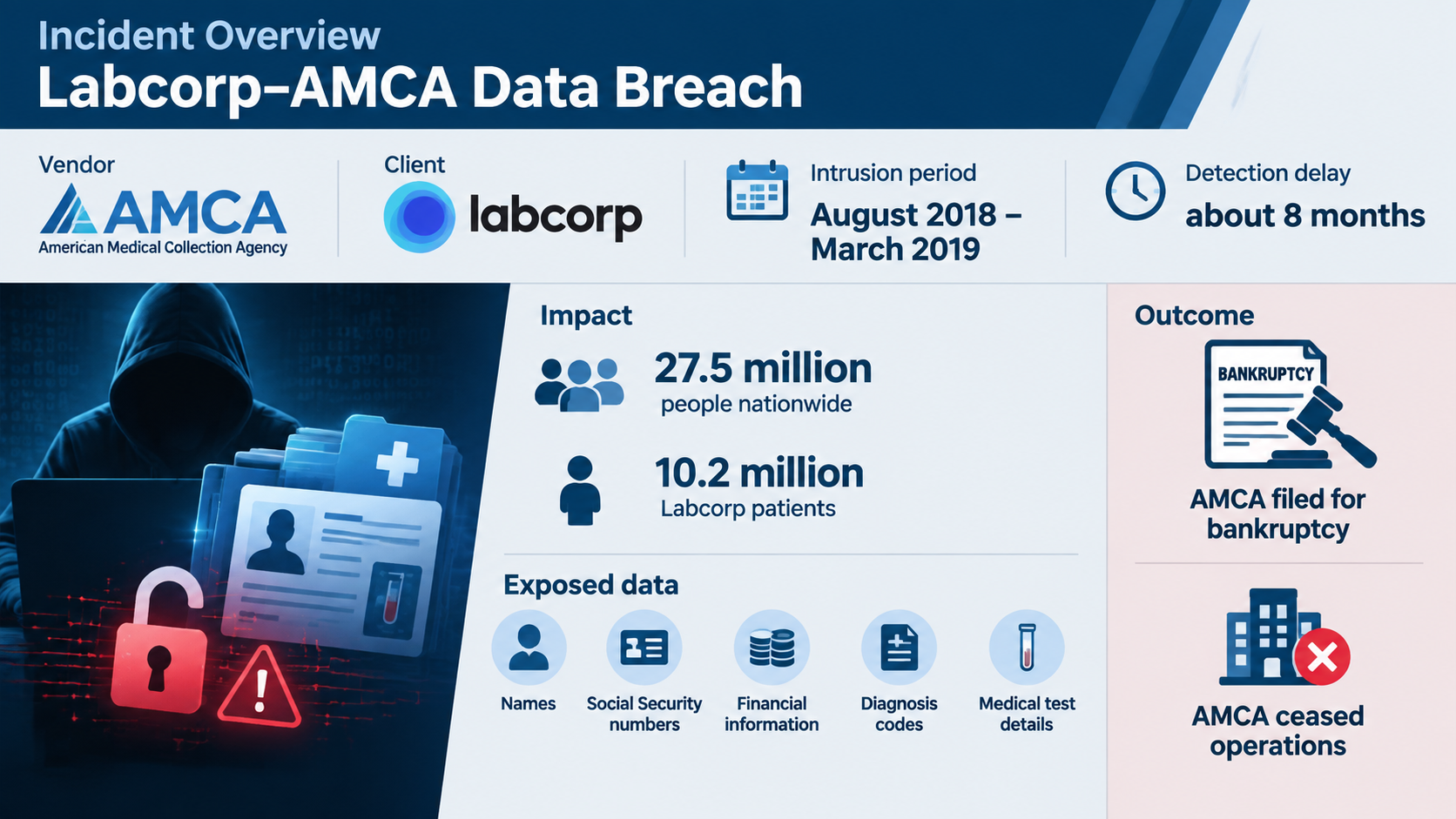
Between August 2018 and March 2019, attackers breached American Medical Collection Agency (AMCA), a debt collector serving Labcorp, exposing the data of 27.5 million people nationwide, including 10.2 million Labcorp patients. In September 2026, 44 state attorneys general announced a $2.3 million settlement with Labcorp, requiring sweeping data security reforms and stronger vendor oversight. The case shows that organizations cannot outsource data protection obligations: Labcorp was held accountable for AMCA’s weak security, including missing antivirus scans, ineffective SIEM logging, no web application firewall, and poor incident tracking. Regulators increasingly expect continuous vendor monitoring, contractual cybersecurity requirements, data minimization, and incident response plans that cover third parties. Companies should tier vendors by risk, audit compliance, limit shared data, and use technology that provides continuous visibility into data flows and user behavior.

Mitigating Healthcare Data Breach Risks: Lessons from the CareCloud 3.7 Million Patient Data Leak and AI-Driven Prevention Solutions

Mitigating Healthcare Data Breach Risks: Lessons from the CareCloud 3.7 Million Patient Data Leak and AI-Driven Prevention Solutions

The 2026 CareCloud data breach, which exposed the personal health information (PHI) of over 3.75 million patients, has once again highlighted the severe cybersecurity vulnerabilities within the global healthcare technology industry. As a leading healthcare IT provider offering electronic health records (EHR) and medical data management services, CareCloud’s cloud environment intrusion incident resulted in massive sensitive patient data exfiltration, triggered regulatory reporting obligations, and brought long-term identity theft and phishing risks to affected individuals. Traditional Data Loss Prevention (DLP) solutions, relying on fixed and rigid rule sets, fail to detect emerging and irregular data exfiltration behaviors such as unauthorized cloud disk data transmission, becoming a key bottleneck in healthcare data security governance. This article analyzes the details and root causes of the CareCloud data breach, summarizes systematic prevention and mitigation strategies for healthcare enterprise data leakage risks, and finally introduces the core value of AI-powered PrivateDLP in making up for traditional DLP deficiencies and preventing similar large-scale healthcare data breaches.

Bridging the Gap: From Security Fundamentals to AI-Driven Data Protection

Bridging the Gap: From Security Fundamentals to AI-Driven Data Protection

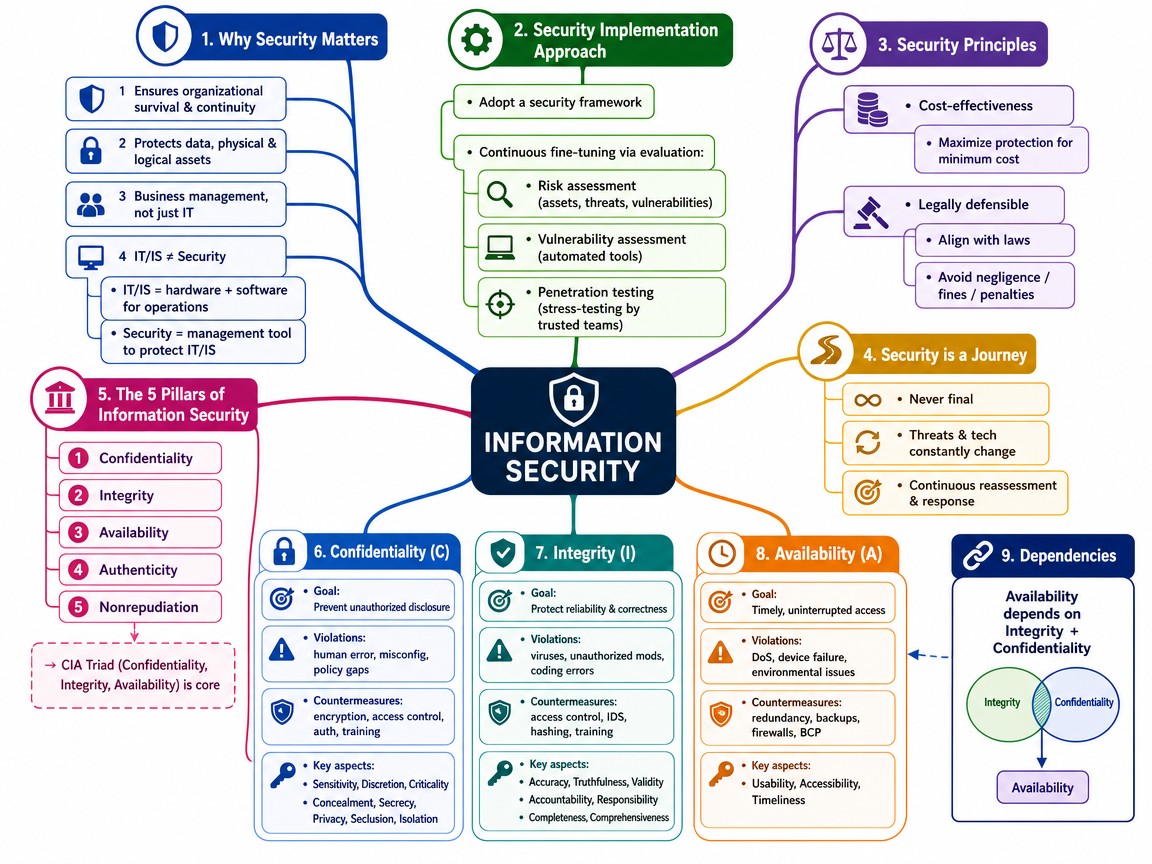
Security is indeed a journey. But with PrivateDLP, you are not walking that path blindfolded. By combining the foundational principles of confidentiality, integrity, and availability with the interpretive power of AI—while fiercely protecting employee privacy and data sovereignty—we ensure that your organization can not only survive but thrive, securely.

From One Compromised Account to 727,000 Exposed Records: Preventing Healthcare Data Breaches

From One Compromised Account to 727,000 Exposed Records: Preventing Healthcare Data Breaches

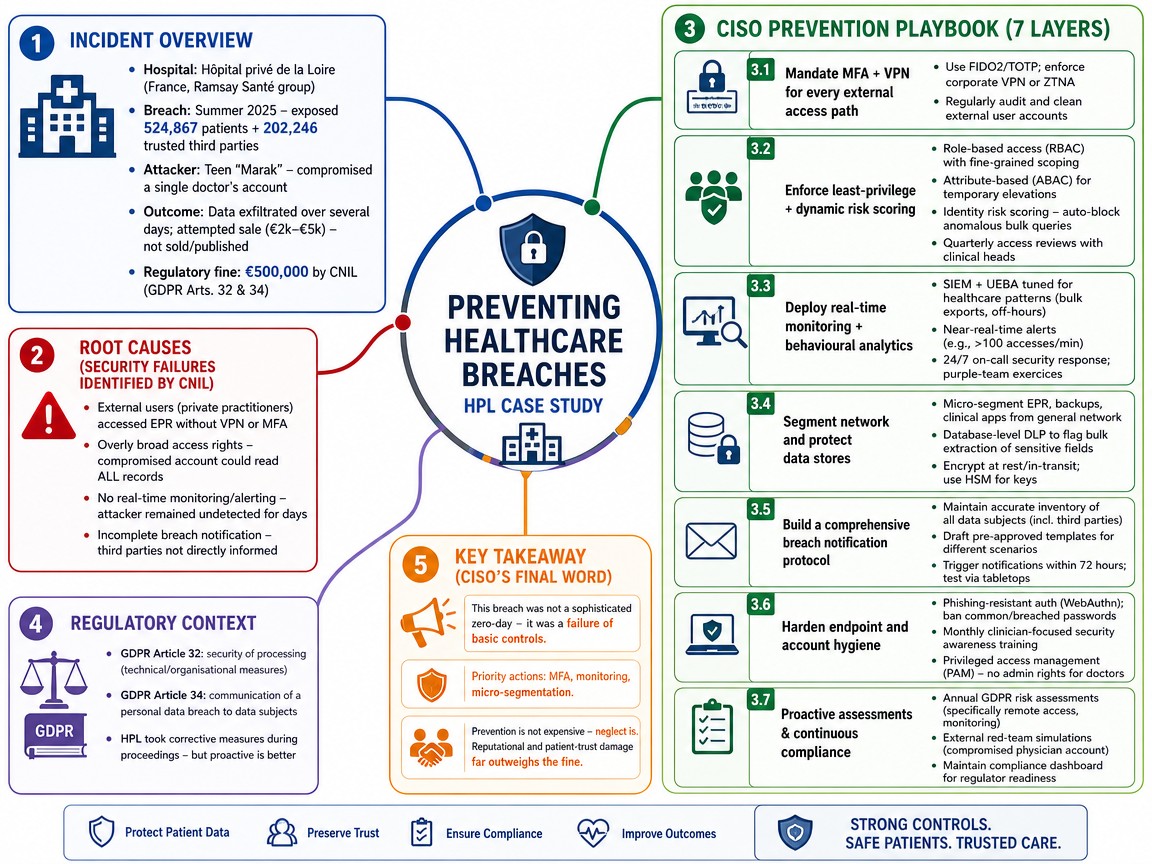
In the summer of 2025, Hôpital privé de la Loire (HPL) – a 333‑bed general hospital in France – suffered a data breach that exposed the sensitive information of 524,867 patients and 202,246 trusted third parties (escorts, family members, or helpers). A teenage attacker, operating under the alias “Marak,” gained initial access through a single doctor’s account, then pivoted to the entire electronic patient record (EPR) system. Over several days, they extracted a massive dataset and attempted to sell it for €2,000–€5,000 (the data was neither sold nor published).

Beyond Static Rules: Rethinking Insider Threat Prevention in the Age of AI Audit

Beyond Static Rules: Rethinking Insider Threat Prevention in the Age of AI Audit

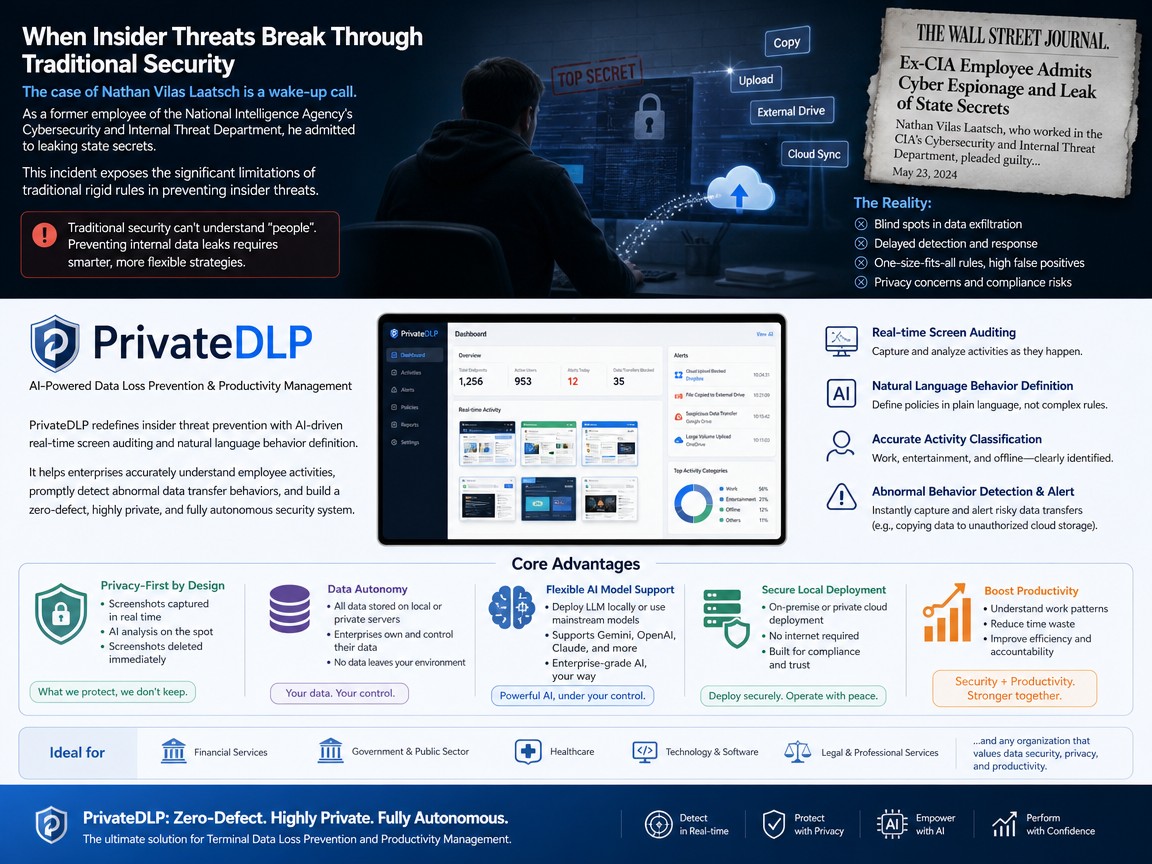
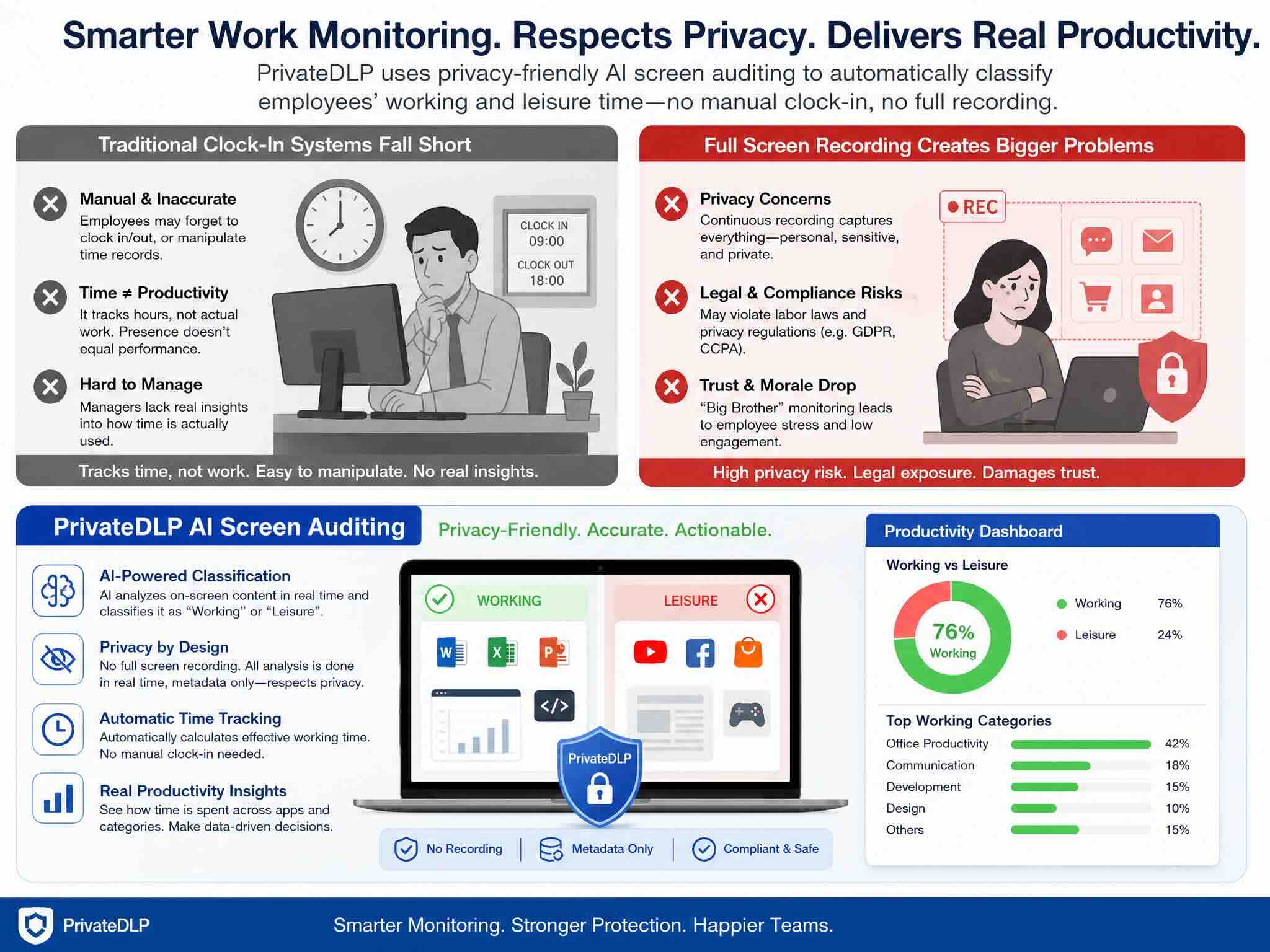
This article begins with the real case of Nathan Vilas Laatsch, a former employee of the National Intelligence Agency's Cybersecurity and Internal Threat Department, who admitted to leaking state secrets. It reveals the significant limitations of traditional rigid rules when dealing with "insider threats" (data leaks by insiders). The article states that preventing internal data leaks requires more intelligent and flexible security strategies. In response to this enterprise pain point, the article introduces the solution PrivateDLP. This software, driven by AI, conducts real-time screen auditing and natural language behavior definition. It can not only accurately track employees' work, entertainment, and offline status, but also promptly capture and alert any abnormal data transfer behavior (such as copying data to unauthorized cloud storage). At the same time, PrivateDLP deeply considers both privacy protection (real-time deletion of screenshots) and data autonomy. It supports local deployment of LLM, mainstream large models (Gemini/OpenAI/Claude), and enterprise self-controlled storage, creating a zero-defect, highly private terminal leakage prevention and productivity management system for enterprises.

The Unseen Threat: When Productivity Becomes a Data Leakage Vector

The Unseen Threat: When Productivity Becomes a Data Leakage Vector

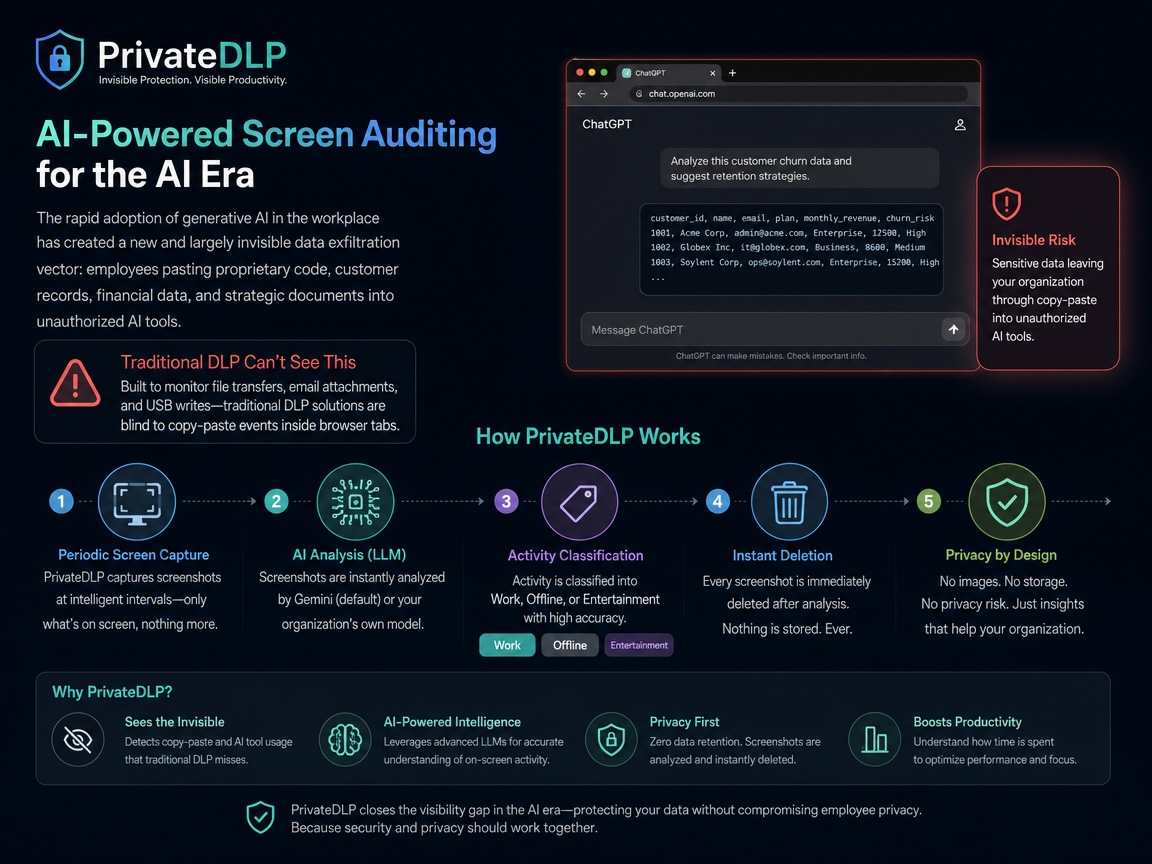
The rapid adoption of generative AI in the workplace has created a new and largely invisible data exfiltration vector: employees pasting proprietary code, customer records, financial data, and strategic documents into unauthorized AI tools. Traditional DLP solutions—built to monitor file transfers, email attachments, and USB writes—are blind to copy-paste events inside browser tabs. PrivateDLP addresses this gap through an AI-powered screen auditing system that captures periodic screenshots, analyzes them via LLM (default Gemini or customer's own model), and classifies employee activity into work, offline, and entertainment time—all while deleting every screenshot immediately to protect privacy.

How to Conduct Employee Screen Monitoring Legally: An AI Audit Solution

How to Conduct Employee Screen Monitoring Legally: An AI Audit Solution

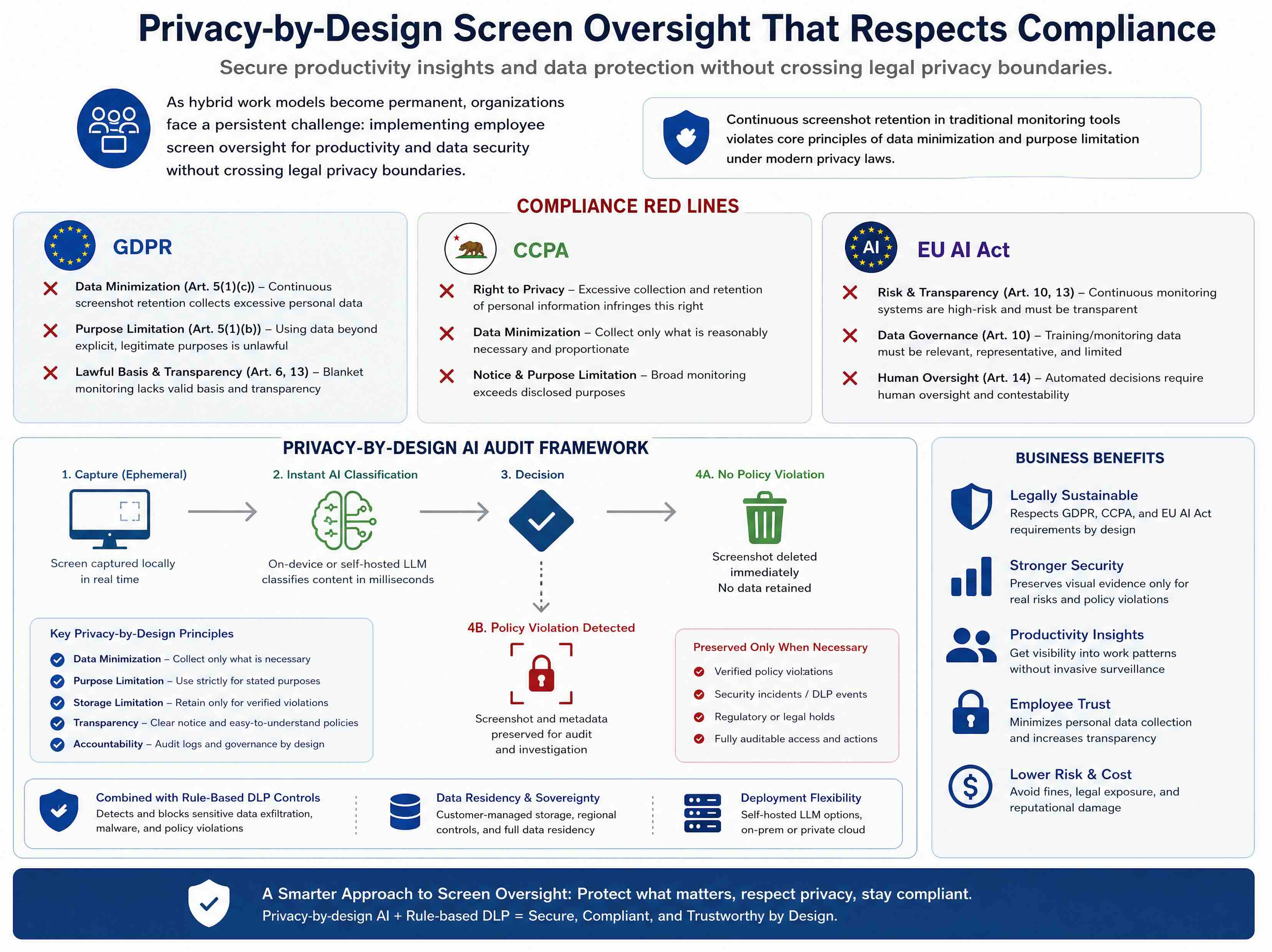
As hybrid work models become permanent, organizations face a persistent challenge: implementing employee screen oversight for productivity and data security without crossing legal privacy boundaries. This article maps critical compliance red lines under GDPR, CCPA, and the EU AI Act, highlighting how continuous screenshot retention in traditional monitoring tools violates core principles of data minimization and purpose limitation. It presents a privacy-by-design AI audit framework that deletes screen captures instantly after LLM classification, preserves visual evidence exclusively for verified policy violations, and enables full data residency via customer-managed storage and self-hosted LLM options. Combined with conventional rule-based DLP controls, this architecture delivers robust endpoint security and productivity insights while minimizing personal data collection, offering a legally sustainable alternative to blanket employee surveillance.

USB Control + AI Screen Audit: A Two-Layer Defense System for Enterprise Data Leak Prevention

USB Control + AI Screen Audit: A Two-Layer Defense System for Enterprise Data Leak Prevention

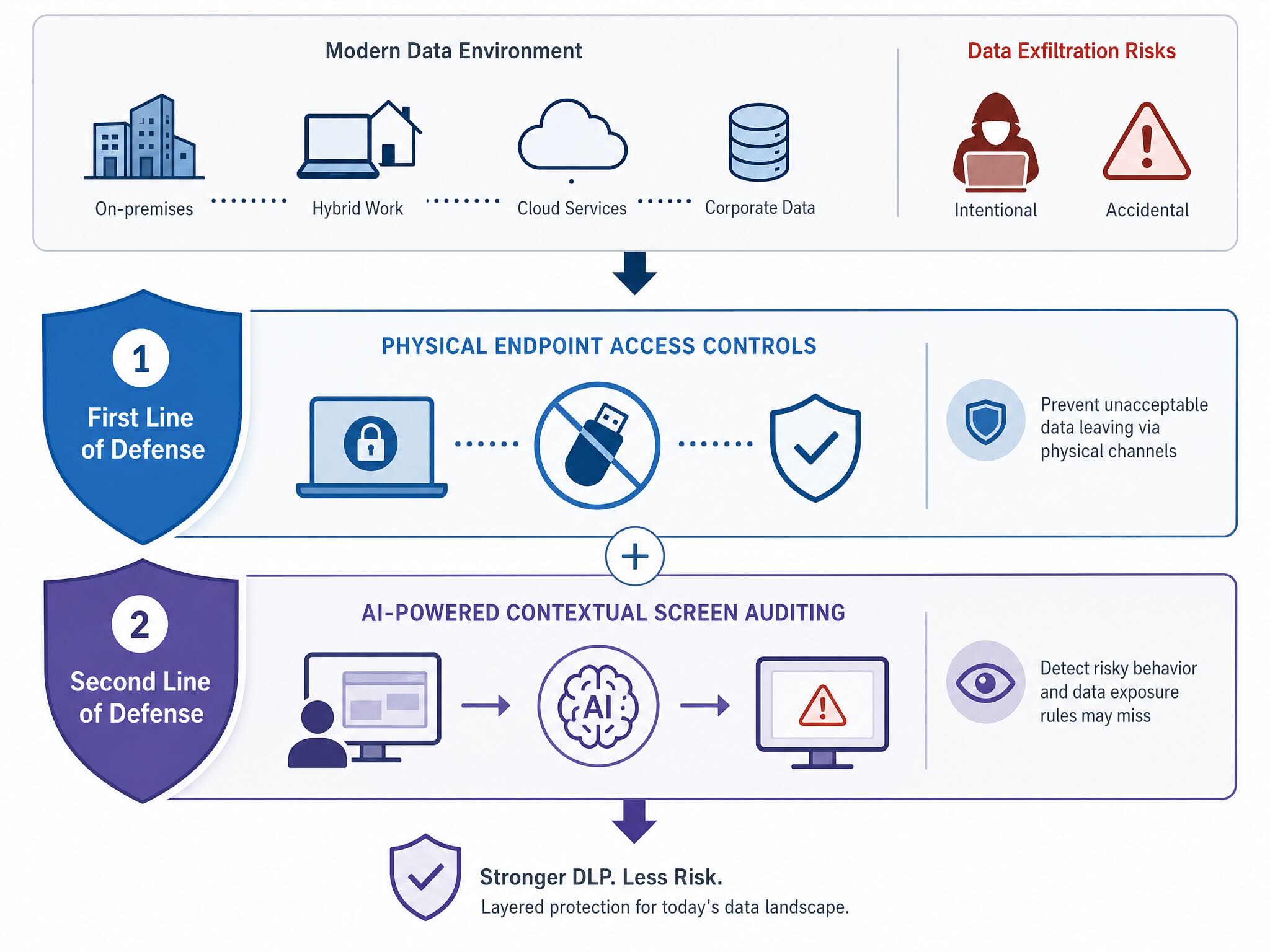
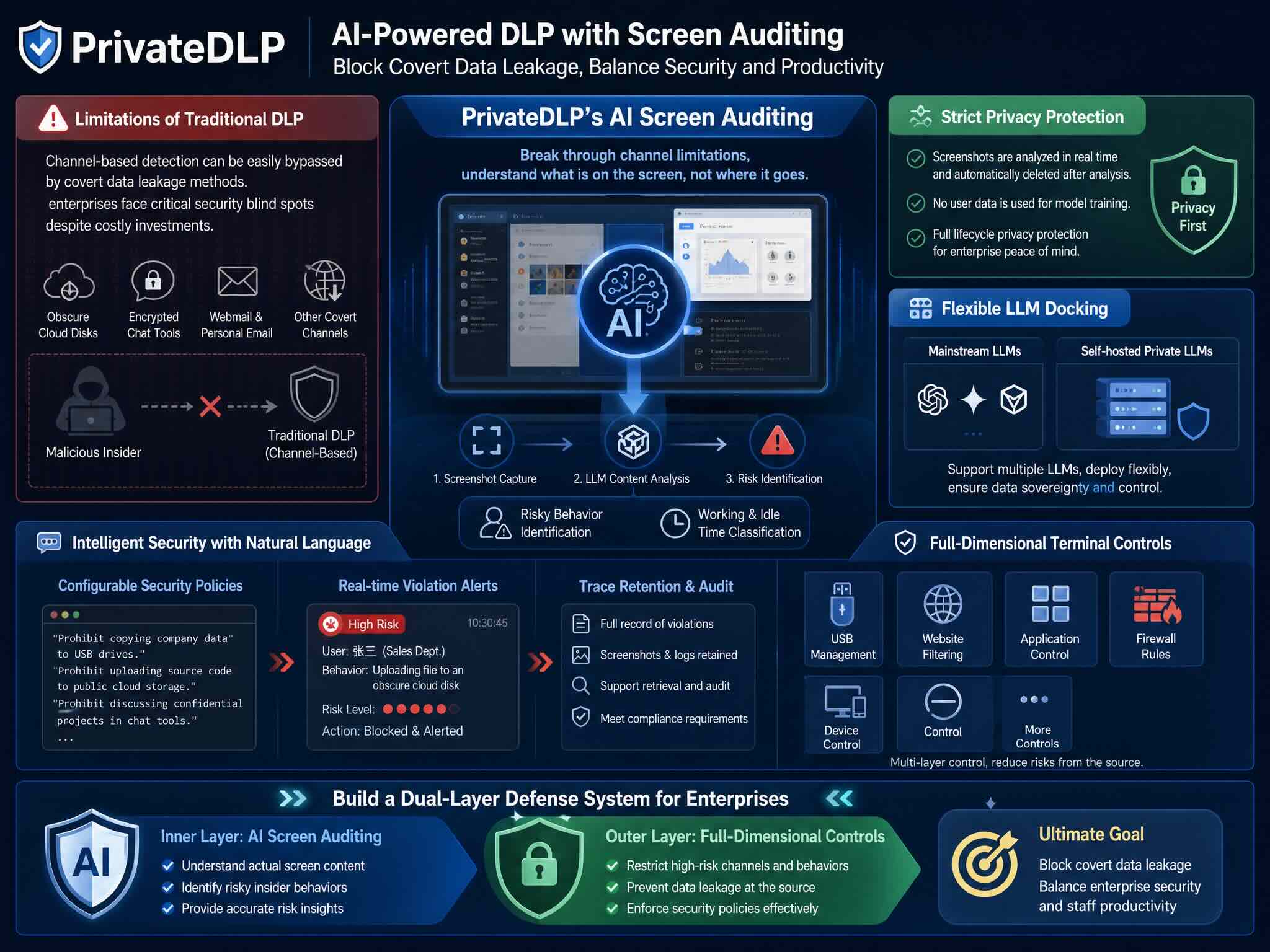
Traditional USB device control forms the essential first layer of enterprise data loss prevention, blocking physical data exfiltration via removable media alongside rule-based web, application, and network controls. However, rigid signature-based DLP systems cannot cover the full range of modern leakage channels, from unlisted cloud services to screen-based data transfer. This article presents a two-layer defense framework that pairs foundational USB and endpoint controls with AI-powered screen auditing. The AI layer uses large language models to detect contextual policy violations that evade static rules, while preserving privacy through instant screenshot deletion, violation-only evidence retention, and support for customer-hosted models and storage.

Data Never Leaves Your Network: AI-Powered Screen DLP Built for On-Premises LLMs

Data Never Leaves Your Network: AI-Powered Screen DLP Built for On-Premises LLMs

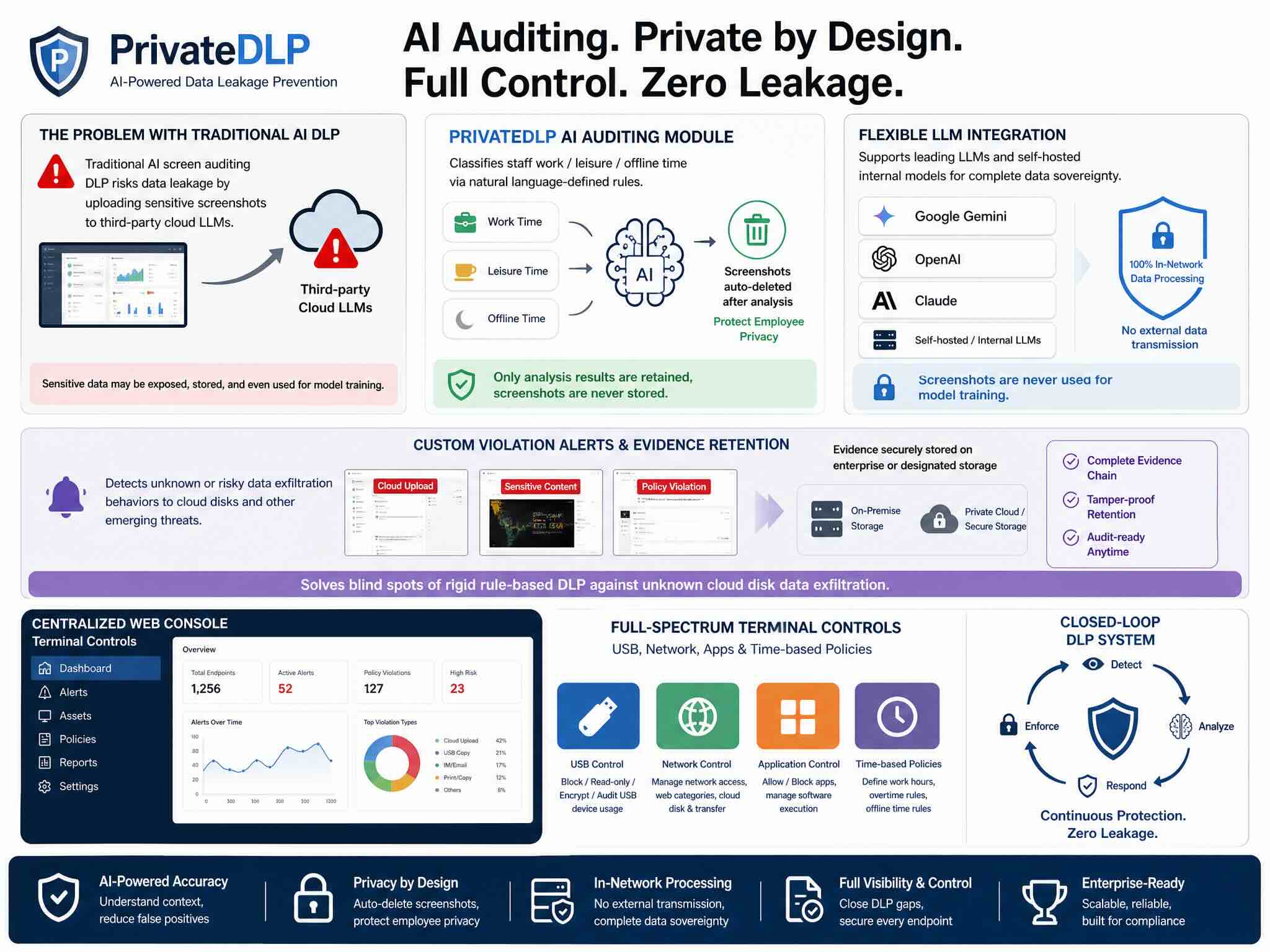
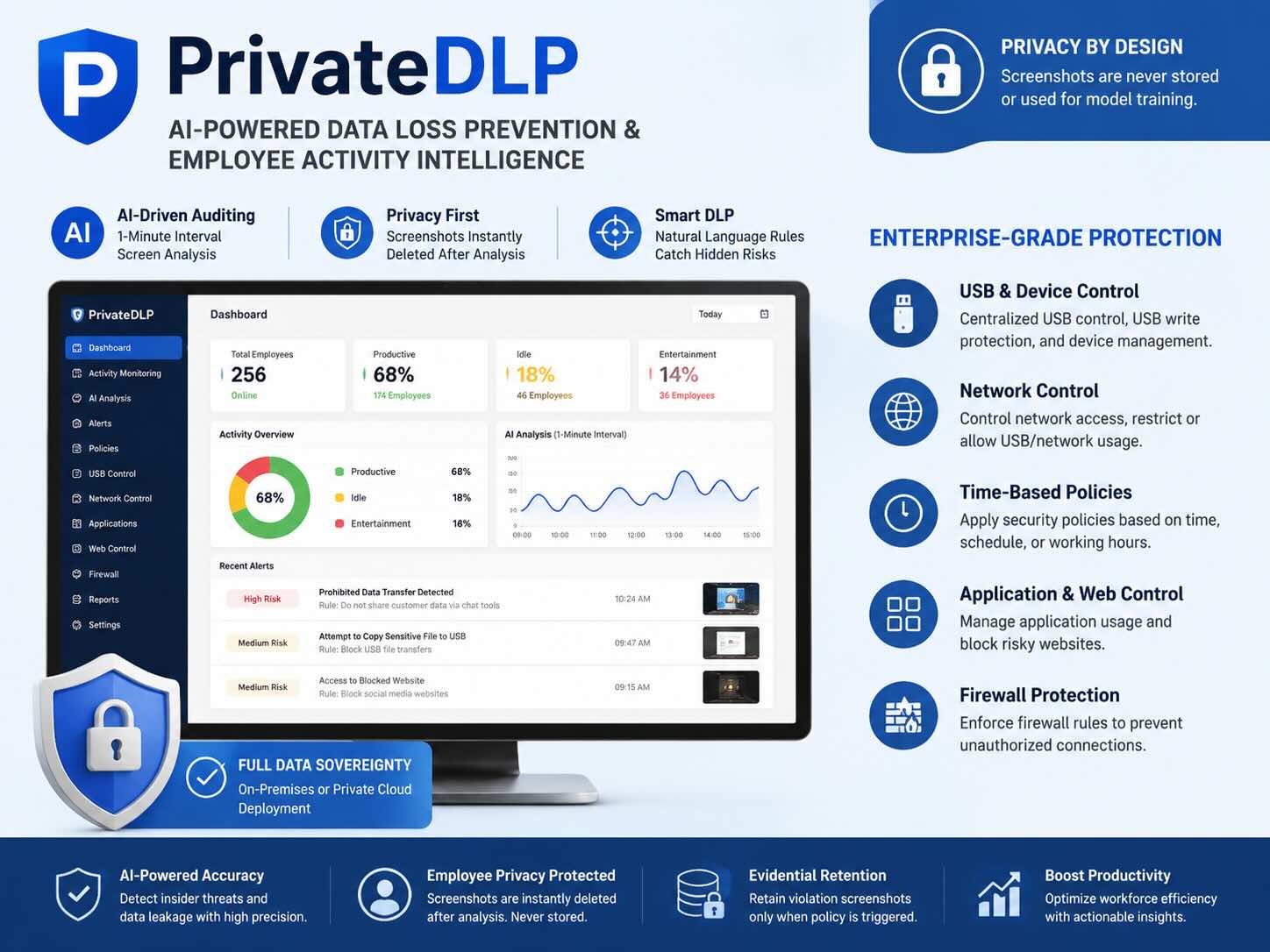
Traditional AI screen auditing DLP risks data leakage by uploading sensitive screenshots to third-party cloud LLMs. PrivateDLP’s AI auditing module classifies staff work/leisure/offline time via natural language-defined rules; screenshots get auto-deleted post-analysis to protect employee privacy. It integrates Gemini, OpenAI, Claude and self-hosted internal LLMs, enabling full in-network data processing without external data transmission, with screenshots never used for model training. Custom violation alerts retain evidence stored on enterprise or designated secure storage, fixing blind spots of rigid rule-based DLP against unknown cloud disk data exfiltration. Equipped with centralized web console terminal controls covering USB, network, apps and time-based policies, it builds a closed-loop enterprise data leakage prevention system.

Can Traditional DLP Stop Data Leaks? AI Screen Auditing Fixes Its Biggest Blind Spot

Can Traditional DLP Stop Data Leaks? AI Screen Auditing Fixes Its Biggest Blind Spot

Traditional rule-based DLP solutions are easily bypassed by covert data leakage methods such as obscure cloud disks and encrypted chat tools, leaving enterprises with critical security blind spots despite costly security investments. Powered by AI screen auditing, PrivateDLP eliminates the limitations of channel-based conventional DLP by analyzing terminal screenshot content via LLMs to identify risky insider behaviors and classify employees’ working and idle time.

USB Disk Security: Enterprise-Grade USB & Endpoint Security for Modern Businesses

USB Disk Security: Enterprise-Grade USB & Endpoint Security for Modern Businesses

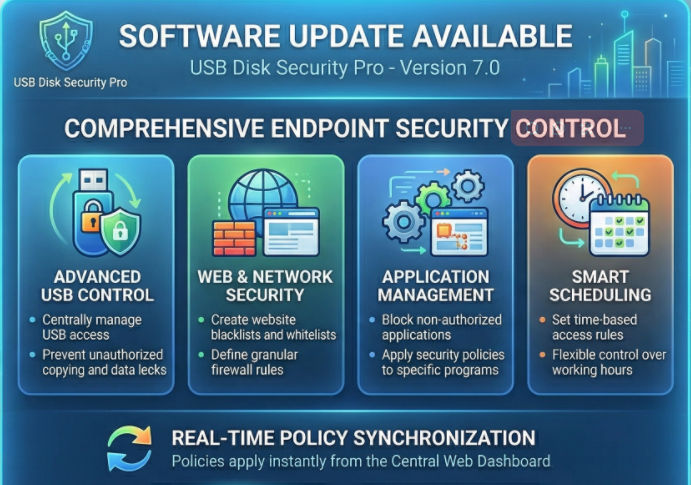
Launched in 2007, USB Disk Security is a mature, user-trusted endpoint security solution with millions of global users. Upgraded from a free lightweight USB antivirus tool, it delivers enterprise-grade protection covering USB virus defense, device access control, data leak prevention, network and application management, and flexible time-based security policies. Supported by a web-based centralized management console, it features simple deployment, powerful all-round threat protection and refined policy control, providing cost-effective, reliable security defense for personal and enterprise endpoints.