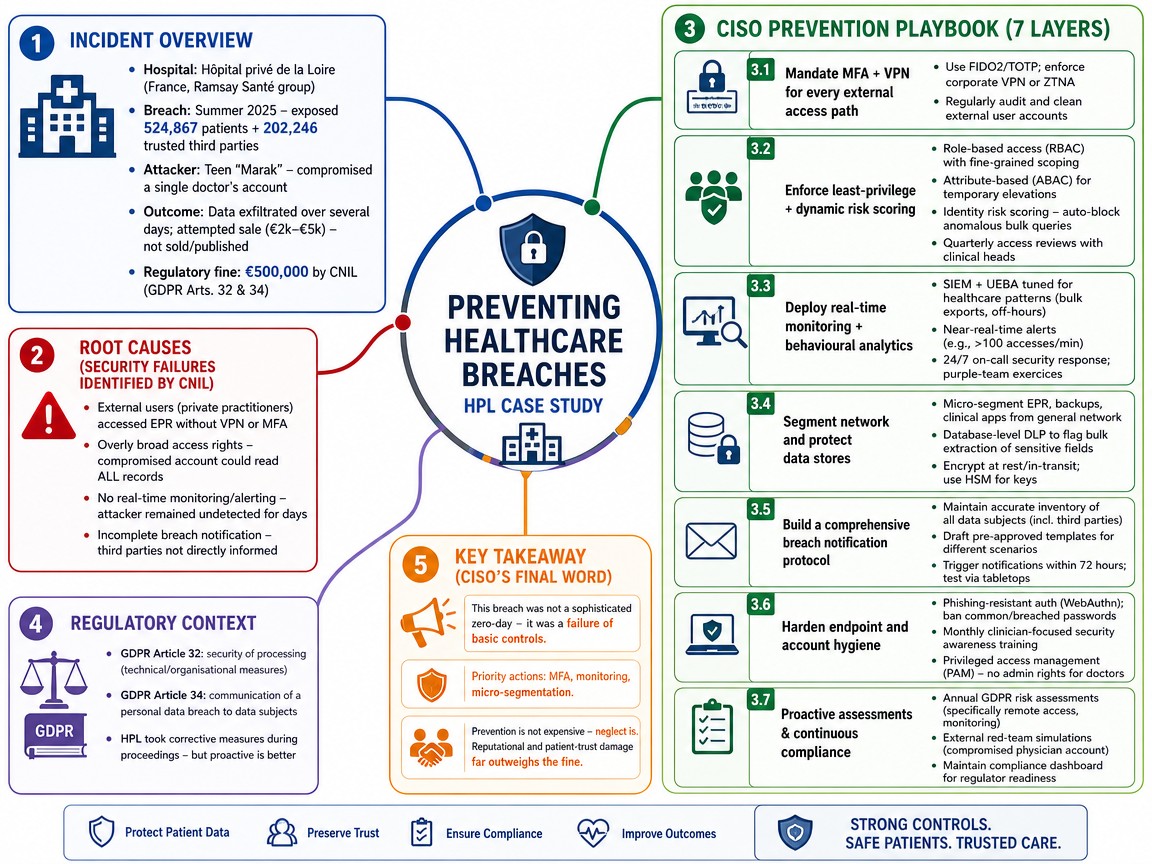
In the summer of 2025, Hôpital privé de la Loire (HPL) – a 333‑bed general hospital in France – suffered a data breach that exposed the sensitive information of 524,867 patients and 202,246 trusted third parties (escorts, family members, or helpers). A teenage attacker, operating under the alias “Marak,” gained initial access through a single doctor’s account, then pivoted to the entire electronic patient record (EPR) system. Over several days, they extracted a massive dataset and attempted to sell it for €2,000–€5,000 (the data was neither sold nor published).
The Incident in Brief
In the summer of 2025, Hôpital privé de la Loire (HPL) – a 333‑bed general hospital in France – suffered a data breach that exposed the sensitive information of 524,867 patients and 202,246 trusted third parties (escorts, family members, or helpers). A teenage attacker, operating under the alias “Marak,” gained initial access through a single doctor’s account, then pivoted to the entire electronic patient record (EPR) system. Over several days, they extracted a massive dataset and attempted to sell it for €2,000–€5,000 (the data was neither sold nor published).
France’s CNIL investigated and fined the hospital €500,000 for multiple GDPR violations (Articles 32 and 34). The key security failures:
No VPN or MFA for external users (including private-practice physicians).
Overly permissive access controls – the compromised account could read all patient records.
No real‑time monitoring or alerting – the attacker roamed freely for days.
Incomplete breach notification – trusted third parties were not directly informed.
A CISO’s Reflection: This Could Have Been Prevented
As CISOs, we know that healthcare environments are uniquely challenging: legacy systems, diverse user groups (staff, contracted doctors, external partners), and the absolute priority of patient care often clash with security hygiene. Yet the HPL case is not a sophisticated supply‑chain attack or zero‑day exploit – it is a failure of basic security controls. Below is a practical, layered prevention framework derived from this incident.
1. Mandate MFA + VPN for Every External Access Path
Why: The attacker used a doctor’s credentials – likely phished, guessed, or reused from another breach. Without MFA, that single password was the golden key.
What to do:
Enforce MFA (preferably FIDO2 or TOTP) for all remote and external users, including private practitioners, vendors, and administrative staff.
Require a corporate VPN or a zero‑trust network access (ZTNA) solution for any connection to the EPR from outside the hospital’s physical network.
Regularly audit external user accounts – remove inactive ones and enforce periodic credential rotation.
2. Implement Least‑Privilege Access with Dynamic Risk Scoring
Why: The compromised account had unfettered read access to all 727,000 records. That is a cardinal sin of identity governance.
What to do:
Adopt a role‑based access control (RBAC) model with fine‑grained scoping – e.g., a cardiologist should only see cardiology patients, not oncology or maternity.
Use attribute‑based access control (ABAC) for temporary or elevated needs (e.g., emergency override with audit trail).
Integrate identity risk scoring – if an account suddenly queries thousands of records in a short time, step‑up authentication or block the session.
Conduct quarterly access reviews with clinical department heads to validate permissions.
3. Deploy Real‑Time Monitoring and Behavioural Analytics
Why: The attacker explored the system and exfiltrated data over several days without any alert. That is a detection gap no CISO can afford.
What to do:
Deploy a SIEM + UEBA (User and Entity Behaviour Analytics) solution tuned for healthcare data patterns – e.g., bulk downloads, unusual query times (3 a.m.), or access from unfamiliar IPs.
Set up near‑real‑time alerting for anomalous activities (e.g., >100 record accesses per minute, or export operations).
Ensure alerts reach an on‑call security team 24/7 – not just a dashboard that nobody watches.
Run regular purple‑team exercises to test detection and response times.
4. Segment the EPR and Critical Data Stores
Why: Once inside, the attacker moved laterally to the entire internal system. Flat networks magnify a single breach.
What to do:
Micro‑segment the network: separate the EPR database, backup servers, and clinical applications from general user workstations and guest Wi‑Fi.
Use data loss prevention (DLP) at the database level to block or flag bulk extraction of sensitive fields (e.g., social security numbers, diagnosis codes).
Encrypt data at rest and in transit, and store encryption keys in a hardware security module (HSM) with strict access.
5. Build a Comprehensive Breach Notification Protocol
Why: HPL notified patients but ignored the 202,246 third parties. Under GDPR, “data subjects” include any natural person whose data is processed – not just patients.
What to do:
Maintain an up‑to‑date inventory of all data subjects and their contact details, including relatives, guardians, and emergency contacts.
Draft pre‑approved notification templates for different scenarios (patients, staff, third parties, regulators).
Establish a clear internal process – legal, comms, and security – to trigger notifications within 72 hours of discovery, as GDPR requires.
Test this process with tabletop exercises at least twice a year.
6. Harden Endpoint and Account Hygiene
Why: The initial compromise was a doctor’s account – likely due to weak password or phishing.
What to do:
Deploy phishing‑resistant authentication (e.g., WebAuthn).
Enforce password policies that ban common passwords and check against known breached credential databases.
Provide monthly security awareness training tailored to clinicians – focusing on social engineering, secure email practices, and reporting suspicious activities.
Use privileged access management (PAM) for administrative accounts – no doctor should have admin rights.
7. Learn from the Incident – and the Investigation
HPL did take strengthening measures during the proceedings – a reactive step. Proactive CISOs should:
Conduct annual GDPR‑aligned risk assessments that explicitly test remote access, monitoring, and notification plans.
Engage an external red team to simulate an attacker with a compromised physician account – this will expose exactly the gaps seen at HPL.
Document all security controls and their effectiveness in a continuous compliance dashboard, ready for regulators.
Final Word
The CNIL fine is modest (€500k), but the reputational damage and loss of patient trust are incalculable. The HPL breach is a textbook case of over‑reliance on perimeter trust and under‑investment in visibility and least privilege. As CISOs, we cannot eliminate every risk, but we can eliminate these elementary failures. Start with MFA, monitoring, and micro‑segmentation – because the next attacker may not be a teenage hacker trying to sell data; they may be a ransomware gang that encrypts your EPR and halts patient care.
Prevention is not expensive – neglect is.