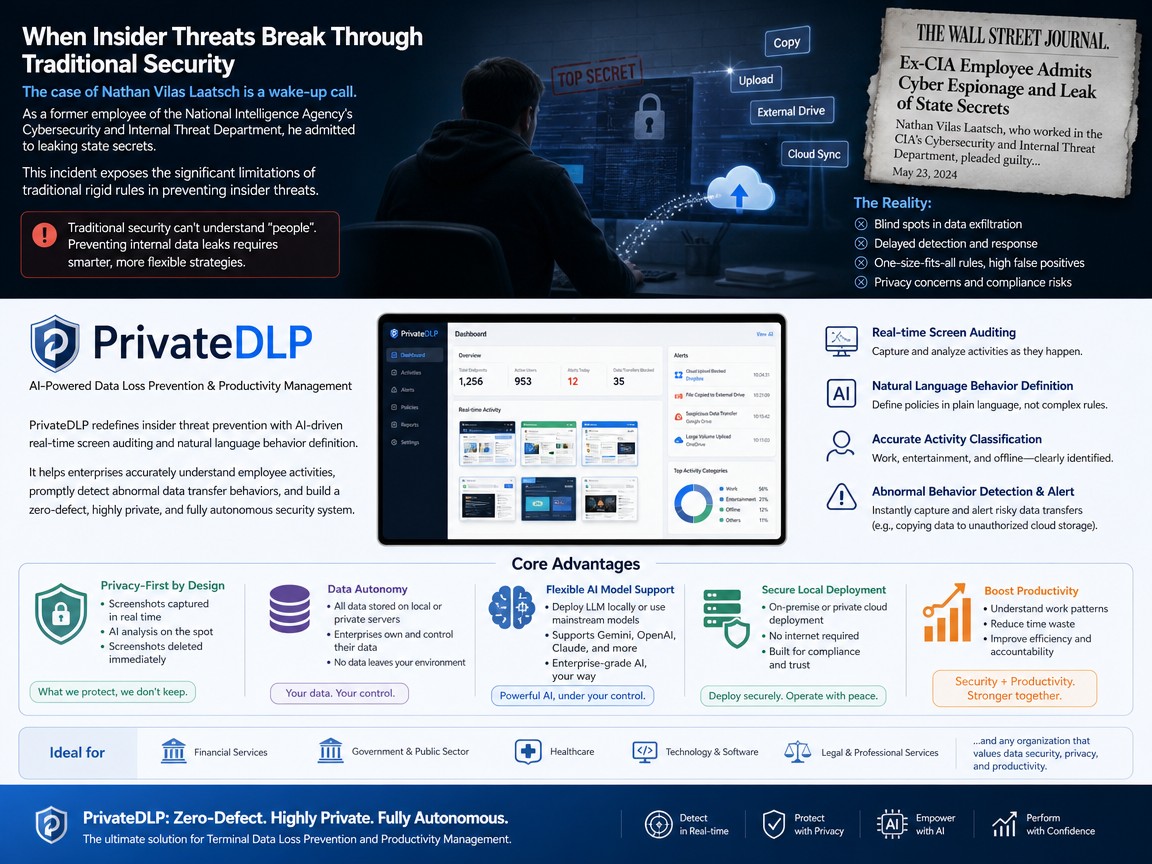
This article begins with the real case of Nathan Vilas Laatsch, a former employee of the National Intelligence Agency's Cybersecurity and Internal Threat Department, who admitted to leaking state secrets. It reveals the significant limitations of traditional rigid rules when dealing with "insider threats" (data leaks by insiders). The article states that preventing internal data leaks requires more intelligent and flexible security strategies. In response to this enterprise pain point, the article introduces the solution PrivateDLP. This software, driven by AI, conducts real-time screen auditing and natural language behavior definition. It can not only accurately track employees' work, entertainment, and offline status, but also promptly capture and alert any abnormal data transfer behavior (such as copying data to unauthorized cloud storage). At the same time, PrivateDLP deeply considers both privacy protection (real-time deletion of screenshots) and data autonomy. It supports local deployment of LLM, mainstream large models (Gemini/OpenAI/Claude), and enterprise self-controlled storage, creating a zero-defect, highly private terminal leakage prevention and productivity management system for enterprises.
The recent guilty plea of Nathan Vilas Laatsch—a former Defense Intelligence Agency (DIA) IT specialist ironically stationed in the agency’s Insider Threat Division—serves as a chilling wake-up call for intelligence and corporate security leaders alike. Laatsch, 29, admitted to transcribing Secret and Top Secret information, concealing notes in his clothing, and dropping thumb drives in public parks for what he believed to be a foreign agent.
This case exposes a fundamental flaw in traditional Data Loss Prevention (DLP) frameworks: static, rigid security rules are often blind to human ingenuity. When a bad actor—or simply a negligent employee—bypasses traditional network boundaries by copying sensitive files to unapproved cloud drives, taking unauthorized screenshots, or slowly leaking data in unconventional ways, legacy DLP software frequently fails to raise an alarm.
To counter these sophisticated insider risks without stifling daily productivity, modern enterprises are turning to next-generation solutions like PrivateDLP—an intelligent security ecosystem that pairs proactive AI auditing with absolute user privacy.
How PrivateDLP Redefines Insider Risk Management and Productivity
Unlike legacy monitoring software that relies solely on fixed keyword matching or rigid port-blocking, PrivateDLP integrates advanced Large Language Model (LLM) vision technology to dynamically interpret user behavior on endpoints.
1. AI-Driven Productivity & Behavioral Auditing
PrivateDLP periodically captures screen state (roughly every minute) and leverages LLM capabilities (using Google Gemini by default) to measure active work, idle time, and leisure activities.
Natural Language Rule Definitions: Administrators no longer need to maintain complex blacklists of websites or application names. Instead, they can simply define what constitutes "leisure" or "non-compliant behavior" using plain, natural language prompt instructions.
Smart Time-Window Management: Flexible scheduling enables custom rules based on specific hours and days of the week, helping balance workplace flexibility with corporate oversight.
2. Advanced Anomaly Detection Beyond Rigid Rules
The core vulnerability exploited by insider threats is the gap between rigid DLP policies and real-world actions. PrivateDLP addresses this by allowing administrators to configure custom alert rules for rule violations.
When an unauthorized action occurs—such as attempting to transfer corporate assets to unrecognized cloud drives or questionable web services—the system triggers an immediate admin notification and preserves the exact screenshot context for forensic evaluation. Higher-tier Pro editions support securely archiving alert screenshots to either client-designated private storage or encrypted cloud environments.
3. Privacy-First Architecture
Mass monitoring often sparks severe privacy concerns among staff. PrivateDLP solves this through a privacy-by-design approach:
Zero-Retention Routine Screenshots: All routine background screenshots used for productivity calculations are processed immediately and deleted on the fly.
No AI Model Training: Routine screenshot data processed by the default Gemini models is never used to train base AI models.
4. Total AI Sovereignty and Enterprise Governance
Recognizing that enterprise security requirements vary, PrivateDLP offers total flexibility in model deployment. Organizations can choose to route screen analysis through default Gemini engines, connect to alternative AI vendors like OpenAI or Claude, or keep everything strictly on-premise by running locally deployed LLMs. With on-premise deployment, corporate data never leaves the local perimeter.
5. Enterprise-Grade Endpoint Controls
In addition to AI-powered visual analysis, PrivateDLP provides robust core defense controls via a centralized Web Management Console:
Device & USB Control: Remotely restrict or block USB read/write access to prevent rogue hardware data extraction.
Application & Web Governance: Enforce custom software blocklists and domain blacklists/whitelists.
Network Firewall Rules: Block unauthorized applications from reaching external networks at the transport layer.
Conclusion
The DIA insider threat incident demonstrates that traditional security perimeters are no longer enough. Protecting sensitive corporate IP requires continuous, intelligent contextual oversight. By combining flexible LLM-powered visual auditing, custom alert preservation, and zero-trust privacy controls, PrivateDLP bridges the gap between rigid enforcement and real-world security—ensuring that enterprise data stays where it belongs, while boosting organizational productivity.