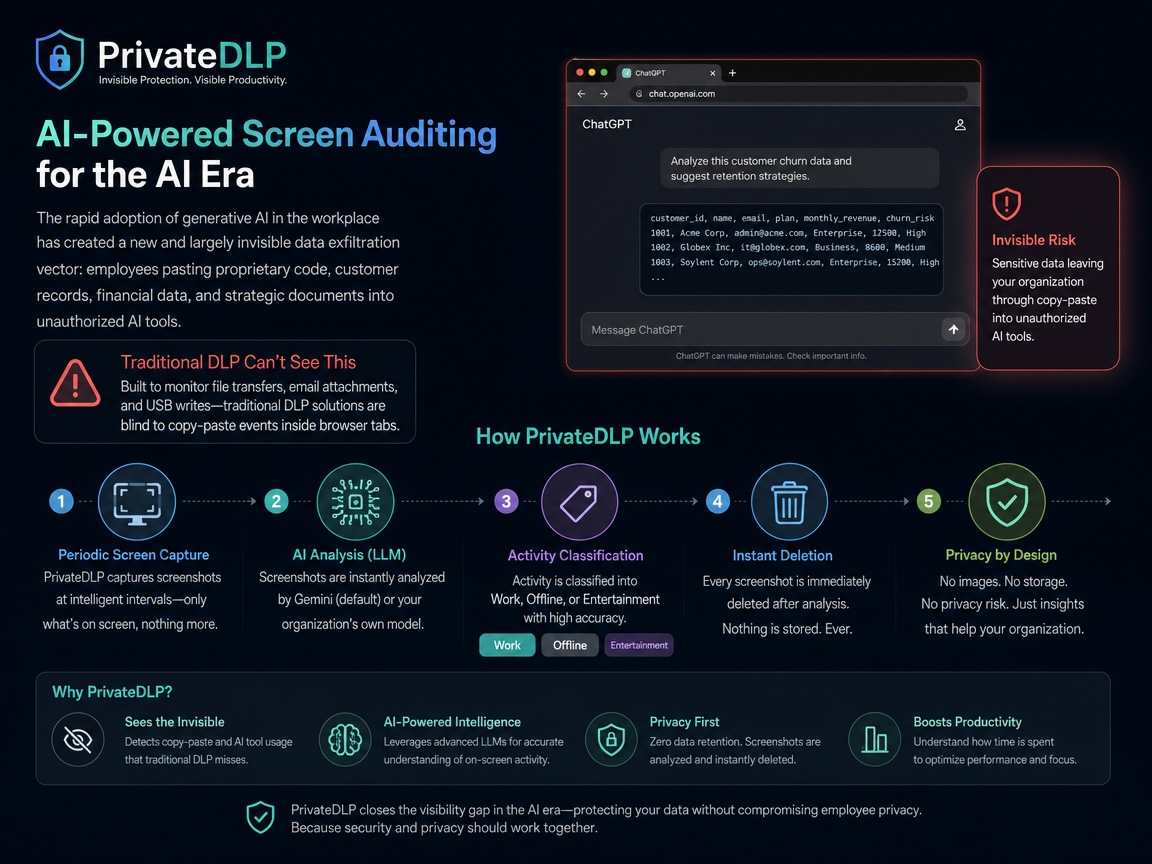
The rapid adoption of generative AI in the workplace has created a new and largely invisible data exfiltration vector: employees pasting proprietary code, customer records, financial data, and strategic documents into unauthorized AI tools. Traditional DLP solutions—built to monitor file transfers, email attachments, and USB writes—are blind to copy-paste events inside browser tabs. PrivateDLP addresses this gap through an AI-powered screen auditing system that captures periodic screenshots, analyzes them via LLM (default Gemini or customer's own model), and classifies employee activity into work, offline, and entertainment time—all while deleting every screenshot immediately to protect privacy.
The employee who pastes proprietary source code into ChatGPT to debug a function faster. The analyst who feeds a quarterly earnings summary into an AI writing tool. The HR manager who uploads a spreadsheet of employee compensation data to generate a pivot table. None of them meant to create a security incident—yet they all did. This is the defining challenge of AI insider threats in 2026: the most dangerous version is not a rogue employee trying to steal data, but a productive one trying to get work done.
The scale is staggering. According to the Zscaler 2026 AI Threat Report, there has been a 93% year-over-year increase in employees transferring enterprise data to AI tools, with over 18,033 TB of data—equivalent to 3.6 billion digital photos—transferred to AI and machine learning applications in the past year alone. Zscaler identified over 410 million DLP policy violations related to ChatGPT alone, representing a 99% year-over-year increase. Even more concerning: employees input sensitive data into AI tools on average once every three days, and most of it never trips a single rule in legacy DLP systems.
Code leakage is the most common type of sensitive data sent to GenAI tools, prevalent across ChatGPT, Claude, DeepSeek, and Baidu Chat. The consequences are real: in 2023, Samsung engineers used ChatGPT to debug code, inadvertently leaking proprietary source code and sensitive internal documents—trade secrets that ended up on OpenAI's servers with no ability to retrieve or delete them.
Why Legacy DLP Fails Against AI Tools
Traditional DLP was built around content inspection at fixed transfer points: email attachments, USB writes, known cloud upload destinations. That architecture assumes data moves in discrete, identifiable units. Generative AI breaks those expectations entirely.
An employee copying a paragraph from a confidential document and pasting it into a ChatGPT prompt involves no file movement, no attachment, and no network event that triggers a traditional alert. The text simply changes location inside a browser tab. A DLP engine watching for attachments will never observe a paste event. Pattern matching against conversational text produces high false positive rates—a prompt containing a name and a number could be a customer record or could be nothing.
Meanwhile, employees are adopting unapproved AI tools faster than IT can govern them, creating massive "Shadow AI" visibility gaps. Nearly 80% of AI adopters bring their own AI tools to work, and nearly 60% rely on unmanaged AI apps. With 82% of pastes coming from unmanaged personal accounts, enterprises have little to no visibility into what data is being shared.
PrivateDLP: AI-Powered Screen Intelligence That Sees What Others Miss
PrivateDLP addresses this critical visibility gap through an innovative AI Audit function that fundamentally redefines how enterprises monitor employee activity in the AI era.
How It Works
The system captures screenshots at approximately one-minute intervals and sends them to a Large Language Model (LLM) for analysis. Administrators can use natural language to define what constitutes "entertainment" versus "work" behavior on each employee's computer—no complex rule-writing required. The LLM (defaulting to Google's Gemini) analyzes each screenshot to classify activity into work time, offline time, and entertainment time, providing unprecedented insight into how employees actually spend their time and—critically—what data they are exposing to AI tools.
Privacy by Design
Unlike traditional employee monitoring solutions that retain screenshots indefinitely, PrivateDLP deletes every screenshot immediately after analysis. The system never stores visual records of employee activity; it only retains the classified metadata and alerts. This privacy-first approach addresses the growing concerns around employee surveillance while still providing the visibility security teams need.
Customizable Alerting and Forensic Retention
Administrators can define custom alert rules for policy violations. When an employee violates a defined rule—such as pasting source code into an unauthorized AI chatbot or uploading a confidential document to an unknown cloud storage service—the system immediately notifies the administrator and retains the offending screenshot as evidence. For enterprises requiring long-term audit trails, PrivateDLP Pro supports storing all alert screenshots either in the customer's specified storage or in PrivateDLP's secure storage.
Flexible AI Deployment: Your Data Stays Yours
PrivateDLP recognizes that different enterprises have different security requirements and AI preferences. The system offers multiple deployment options:
Default Gemini Model: Use PrivateDLP's default Google Gemini model for screen analysis, with the assurance that screenshots are never used to train the model
Bring Your Own AI: Connect to your preferred AI vendor—OpenAI, Claude, Gemini, or any other supported provider
On-Premise LLM: Deploy PrivateDLP with your organization's own internally hosted LLM, ensuring that all enterprise data never leaves your internal infrastructure
This flexibility means organizations can maintain complete control over their sensitive data while still leveraging the power of AI for security monitoring.
Comprehensive Enterprise Device Management
Beyond AI-specific protection, PrivateDLP provides a full suite of enterprise device management capabilities:
Remote Device Management: Administrators can manage all endpoint USB and network permissions through a centralized web console
Intelligent Time-Based Controls: Set policies by day of week and time segments for flexible, context-aware enforcement
USB Read-Write Controls: Prevent data exfiltration through removable media
Website Blacklists/Whitelists: Regulate employee browsing behavior
Application Controls: Block unauthorized software from running
Firewall Rules: Control which applications can access the network at the network layer
Detecting the New Threat: Employees Sending Code and Documents to Unauthorized AI
The most urgent threat PrivateDLP addresses is employees sending proprietary code, strategic documents, and customer data to unauthorized AI tools. This behavior is rampant: 77% of employees using generative AI tools regularly copy and paste data into chatbot queries. Copy-paste has now exceeded file transfer as the top corporate data exfiltration vector.
PrivateDLP's screen-based AI audit catches these events in real time—not by scanning network traffic (which sees only encrypted payloads), not by inspecting file movements (which don't occur), but by visually recognizing when an employee has pasted corporate data into an AI prompt field. The system's ability to understand screen content through LLM analysis means it can distinguish between legitimate AI usage (e.g., using an approved corporate AI tool for approved purposes) and policy violations (e.g., pasting source code into a personal ChatGPT account).
Conclusion
The AI era has transformed insider threats from discrete, detectable events into a continuous stream of low-visibility data exposure events. Traditional DLP, built for a world of file transfers and email attachments, is fundamentally unequipped to address this new reality.
PrivateDLP bridges this gap through AI-powered screen intelligence that sees what other tools miss, while preserving employee privacy through immediate screenshot deletion. With flexible AI deployment options that keep enterprise data within organizational control, and comprehensive device management capabilities that address the full spectrum of data leakage vectors, PrivateDLP provides the visibility and protection enterprises need to safely enable AI adoption without compromising security.
In a world where employees are already dumping company data into LLMs, the question is no longer if your organization will experience an AI-related data leakage event—but when you will detect it. PrivateDLP ensures you detect it first.