SOC 2 (System and Organization Controls 2) is a voluntary auditing framework developed by the American Institute of Certified Public Accountants (AICPA) that evaluates how service organizations protect client data. Unlike SOC 1, which focuses on controls relevant to financial reporting, SOC 2 examines controls over security, availability, processing integrity, confidentiality, and privacy—collectively known as the Trust Services Criteria. A SOC 2 report is an attestation issued by a licensed CPA firm, not a certification, and comes in two forms: Type I, which assesses control design at a single point in time, and Type II, which evaluates operating effectiveness over a defined period, typically three to twelve months. This article explains the SOC 2 framework, its five trust services categories, the distinction between report types, the structure of a SOC 2 report, and why SOC 2 compliance has become a de facto requirement for service organizations serving enterprise clients.
What Is SOC 2?
SOC 2, short for System and Organization Controls 2, is a voluntary auditing framework established by the American Institute of Certified Public Accountants (AICPA). It provides a standardized way for service organizations—such as cloud service providers, SaaS platforms, data centers, and managed service providers—to demonstrate that they have effective controls in place to protect client data.
SOC 2 is not a certification. It is an attestation report produced by a licensed CPA firm that describes how well an organization's controls meet a defined set of criteria, either at a specific point in time or over a defined period. The framework is principles-based rather than a rigid checklist, and it evaluates controls against five Trust Services Criteria developed by the AICPA.
The Five Trust Services Criteria
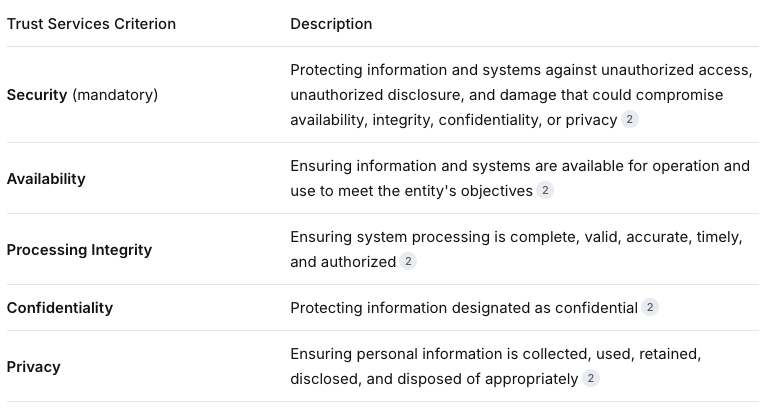
SOC 2 is built around five Trust Services Criteria (TSC). Security is the only mandatory criterion; organizations may select additional criteria based on the nature of their services and customer commitments.
The Security criterion, often referred to as the Common Criteria (CC), encompasses nine operational and governance requirements that apply regardless of which additional criteria are selected, covering areas such as control environment, risk assessment, logical and physical access, systems operations, change management, and risk mitigation.
SOC 2 vs. SOC 1: Key Differences
SOC 1 and SOC 2 serve fundamentally different purposes. A SOC 1 report examines controls at a service organization that could affect a client's financial statements, while a SOC 2 report examines controls tied to security, availability, processing integrity, confidentiality, and privacy. The two reports cover different control objectives and different audiences, so one does not replace the other.
SOC 1 is typically required for service organizations whose services affect clients' financial reporting, such as payroll processors, claims administrators, and transaction processing platforms. SOC 2 is relevant when customers care about how an organization protects their data and keeps systems secure and available. While SOC 1 has a financial reporting lens, SOC 2 addresses operational and security risks.
SOC 2 Type I vs. Type II
SOC 2 reports come in two types, which differ in scope and the level of assurance they provide.
A SOC 2 Type I report assesses whether an organization's controls are suitably designed to meet the Trust Services Criteria at a specific point in time. It is essentially a snapshot that indicates whether the right controls are in place. Type I engagements are typically completed in one to three months and are well-suited for organizations seeking an initial assessment of their control environment.
A SOC 2 Type II report goes further. It assesses whether controls were not only designed appropriately but also operated effectively over a defined period, typically three to twelve months. Type II is significantly more rigorous and is what most enterprise customers and external auditors require. For initial Type II audits, organizations often begin with a three- to six-month observation period; subsequent audits commonly adopt a twelve-month window.
Structure of a SOC 2 Report
A SOC 2 report typically follows a standard structure with four required sections and one optional section:
Independent Service Auditor's Report — The auditor's opinion on whether the controls were suitably designed and, for Type II, operated effectively during the period. The opinion may be unqualified (no issues), qualified (one or more issues), adverse (significant failures), or a disclaimer of opinion (insufficient information).
Management's Assertion — A statement from the service organization's management confirming the accuracy of the system description and the effectiveness of the controls.
Description of the System — A detailed overview of the system under audit, including infrastructure, software, people, procedures, data, and the boundaries of the system being reported on.
Trust Services Criteria and Related Controls — The specific criteria addressed and the controls implemented to meet them, along with the auditor's tests of controls and the results of those tests.
Other Information Provided by Management — An optional section for additional information the organization wishes to include.
Why SOC 2 Matters
SOC 2 has become a de facto requirement for service organizations that store, process, or transmit client data. Many enterprise buyers now expect to review a SOC 2 report before signing or renewing contracts. A SOC 2 report helps customers evaluate a service organization's data security and threat mitigation procedures as part of their vendor risk assessments, building trust with stakeholders and positioning the organization as one that prioritizes security and reliability.
SOC 2 reports may also help demonstrate compliance with regulations such as PCI, HIPAA, and GLBA, though SOC 2 itself is not a regulatory requirement and does not result in a certification. It is best understood as a flexible, principles-based framework that provides independent assurance to customers and partners that an organization takes data security seriously.