We deliver two tiered enterprise terminal security & data loss prevention (DLP) solutions built on a stable Client/Server (C/S) architecture, exclusively supporting Windows endpoints. All device and network governance policies are centrally configured and pushed via a unified web admin dashboard, allowing bulk or individual device policy assignment. Endpoint clients execute server-defined rules and continuously sync monitoring logs back to your enterprise management console, enabling end-to-end visible data leak defense and staff activity oversight.
Brief Product Introductions
1. USB Disk Security (Standard Edition)
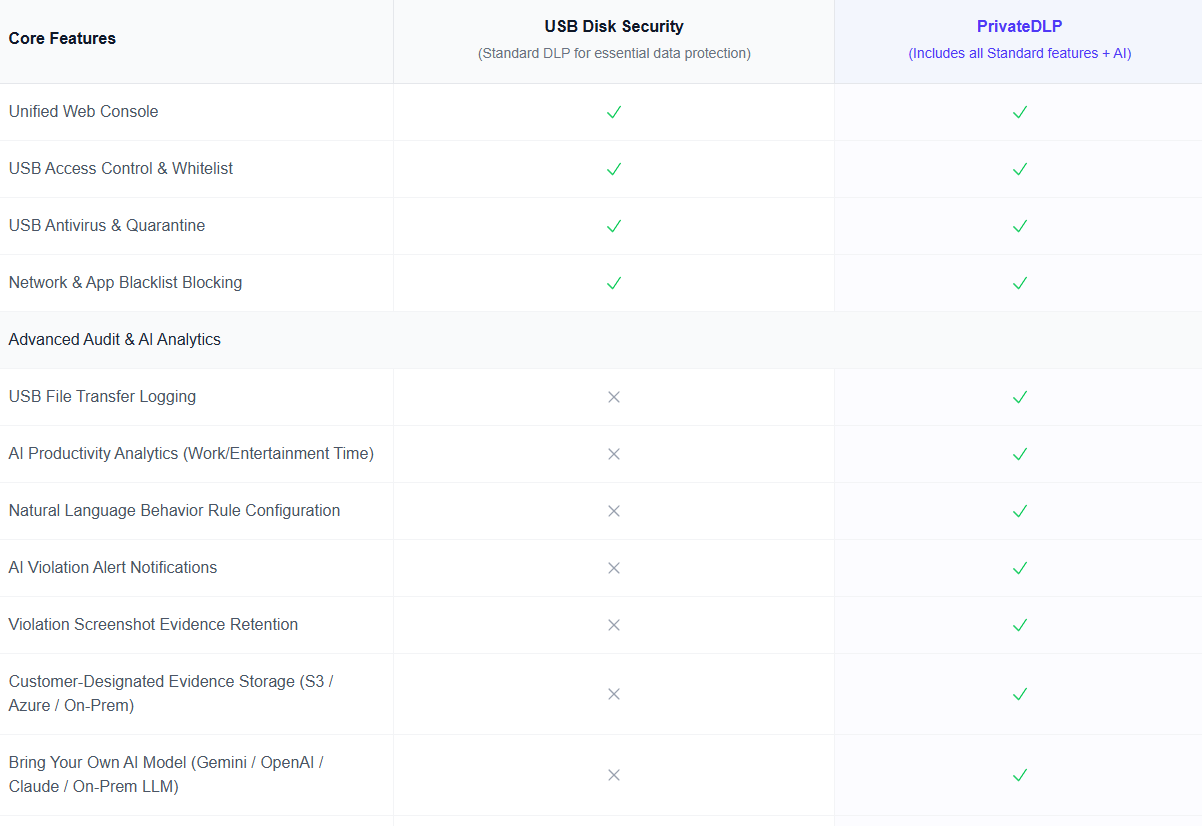
USB Disk Security is our entry-level enterprise DLP solution designed for foundational endpoint protection. It covers core USB security, peripheral access control, and basic network behavior governance without advanced auditing or AI analytics.
This edition is ideal for small-to-midsize businesses seeking affordable, straightforward safeguards against common data leakage vectors: unauthorized USB file exfiltration, malware introduced via portable drives, and unregulated employee web/application usage. Administrators can lock down USB hardware access, block risky websites and prohibited software, and run on-demand or real-time USB malware scans via the web panel.
2. PrivateDLP (Pro Edition)
PrivateDLP Pro retains every capability of USB Disk Security Standard, with an extensive suite of advanced audit, intelligent AI monitoring, and fully customizable enterprise-grade deployment features.
Built to resolve critical limitations of rigid rule-based legacy DLP tools, PrivateDLP adds granular USB file transfer logging, privacy-compliant AI screen auditing, natural language behavior rule setup, flexible alert storage options, and bring-your-own large language model (BYO LLM) integration. It caters to mid-to-large enterprises with strict compliance, productivity tracking, and data residency requirements, delivering deep visibility into hidden data exfiltration risks like unauthorized cloud disk uploads while protecting employee privacy.
Full Feature Comparison Table