This article walks through each phase with practical tips, common pitfalls, and concrete steps to help you not just survive your SOC 2 audit, but derive genuine value from it.
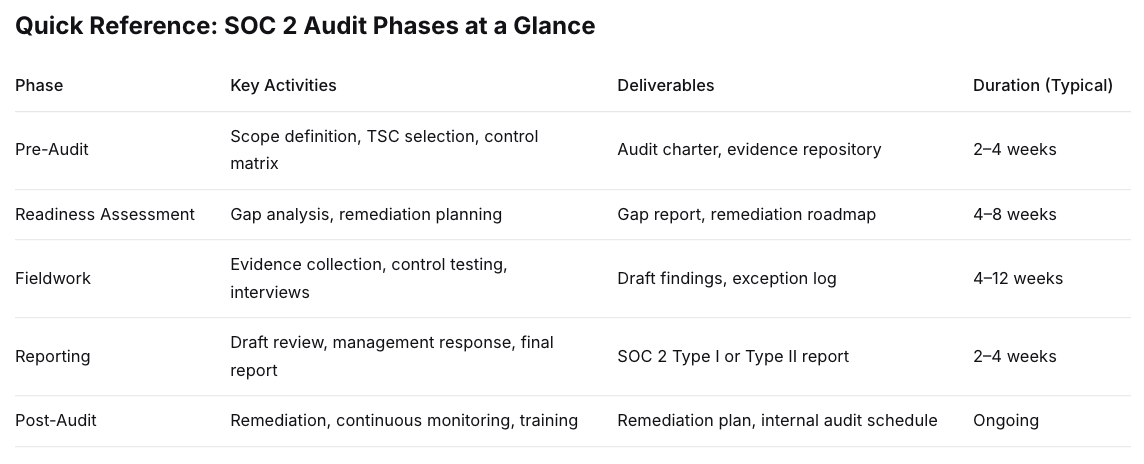
The SOC 2 audit process is structured into distinct phases, each designed to systematically evaluate an organization's adherence to the Trust Services Criteria. Understanding these phases helps organizations prepare effectively, ensuring a smooth audit process and successful compliance outcomes. But beyond understanding, what organizations truly need is actionable guidance—the practical "how-to" that transforms a theoretical framework into an executable strategy.
This article walks through each phase with practical tips, common pitfalls, and concrete steps to help you not just survive your SOC 2 audit, but derive genuine value from it.
Phase 1: Pre-Audit — Laying the Foundation
What Happens:
This initial phase involves preliminary planning and preparation by the organization seeking compliance and the selected SOC 2 auditor. It includes defining the scope of the audit, confirming the Trust Services Criteria that will be addressed, and identifying the systems, processes, and controls to be evaluated. During this phase, the organization and auditor agree on timelines, deliverables, and communication protocols.
Practical Tips:
Define Your Scope Early and Precisely. One of the most common mistakes is an overly broad scope. Ask yourself: Which systems, locations, and business units are in scope? If you're a SaaS company, focus on the production environment that hosts customer data. Don't audit your internal HR system unless clients specifically require it.
Select the Right Trust Services Criteria. SOC 2 is not one-size-fits-all. The five TSC categories are Security (mandatory), Availability, Processing Integrity, Confidentiality, and Privacy. Most organizations start with Security only. Adding Availability and Confidentiality is common for SaaS providers. Only add Privacy if you handle personal data and have mature privacy practices—it's the most demanding category.
Create a Control Matrix. Before the auditor arrives, build a spreadsheet mapping each Trust Services Criteria to your specific controls.
Gather Evidence Proactively. Start organizing documentation now—policies, procedures, screenshots, logs, and tickets. Create a shared folder structure aligned with your control matrix. This will save dozens of hours during fieldwork.
Common Pitfall: Waiting until the auditor asks for evidence. By then, you're reactive and stressed. Proactive documentation collection is the single biggest time-saver.
Phase 2: Readiness Assessment — The Dress Rehearsal
What Happens:
Although not mandatory, a readiness assessment is highly recommended, especially for organizations undergoing a SOC 2 audit for the first time. This assessment is conducted by the auditor or an external consultant to evaluate the organization's preparedness for the SOC 2 audit. It identifies gaps in controls, documentation, or processes that need to be addressed before the formal audit begins.
Practical Tips:
Treat It as a Gap Analysis, Not a Formality. The readiness assessment should produce a prioritized list of gaps. For each gap, assign an owner, a remediation deadline, and a risk rating (High/Medium/Low).
Use the "Auditor's Lens." Ask your readiness assessor: "If you were auditing us tomorrow, where would you find exceptions?" This question surfaces weaknesses you might overlook.
Budget for Remediation. Readiness assessments often reveal that you need new tools (e.g., a SIEM, a vulnerability scanner, or a compliance automation platform). Budget for these before the audit begins, not after.
Common Pitfall: Skipping the readiness assessment to save money. The cost of failing an audit or receiving a qualified opinion far exceeds the cost of a readiness assessment.
Phase 3: Fieldwork — The Heart of the Audit
What Happens:
The fieldwork phase is the heart of the SOC 2 audit, during which the auditor conducts a detailed examination of the organization's controls related to the relevant Trust Services Criteria. This involves reviewing documentation, interviewing personnel, and testing controls to assess their design and operational effectiveness.
Practical Tips:
Prepare Your Team for Interviews. Auditors will interview control owners. Brief your team on what to expect: They should answer questions directly, provide evidence when asked, and never guess. If they don't know an answer, they should say, "I'll find that and follow up."
Understand Testing Methodology. Auditors test controls in two ways: design effectiveness (Is the control designed to meet the criteria?) and operating effectiveness (Did the control operate consistently over the audit period?). For operating effectiveness, they'll take a sample. For example, if you have quarterly access reviews, they'll test all four quarters.
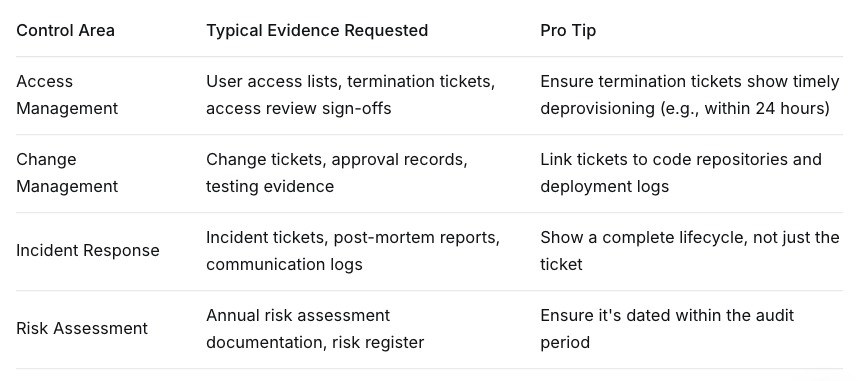
Common Evidence Requests and How to Respond:
Use a Compliance Automation Platform. Tools like Vanta, Drata, or Secureframe can automate evidence collection, continuously monitor controls, and reduce the manual burden on your team. This is especially valuable for startups with lean compliance teams.
Communicate Early and Often. If you discover an exception during fieldwork (e.g., a missed access review), tell the auditor immediately. Hiding it will only make things worse. Auditors appreciate transparency and may adjust their testing approach.
Common Pitfall: Treating the auditor as an adversary. The auditor is not there to "catch" you—they're there to attest to your controls. Collaborate openly, and you'll have a smoother experience.
Phase 4: Reporting — The Moment of Truth
What Happens:
After completing the fieldwork, the auditor analyzes the findings and compiles a SOC 2 report. This report includes a description of the scope and methodology of the audit, the auditor's findings, and any deviations from the SOC 2 criteria. If any issues are identified, the report will also include recommendations for improvement.
Practical Tips:
Understand Report Types. You'll receive either a Type I report (controls designed appropriately as of a specific date) or a Type II report (controls operated effectively over a period, typically 3–12 months). Most customers want a Type II report.
Review the Draft Report Carefully. Before the final report is issued, you'll have a chance to review the draft. Check for:
Accuracy of the system description
Completeness of the scope
Fairness of any exceptions noted
Clarity of the auditor's opinion
Prepare a Management Response. If exceptions are noted, you can include a management response in the report. This demonstrates to customers that you're taking findings seriously. Example:
Exception: One terminated employee's access was not revoked within 24 hours.
Management Response: We have implemented an automated deprovisioning workflow integrated with our HR system. This control was effective as of [date] and will be tested in our next audit.
Distribute Strategically. Share the report under NDA with prospects and customers. Many organizations publish a summary or make the full report available upon request. Never share it publicly without redacting sensitive information.
Common Pitfall: Assuming a "clean" report is the only acceptable outcome. A report with minor exceptions and strong management responses can still satisfy customers—especially if you show continuous improvement.
Phase 5: Post-Audit — From Compliance to Culture
What Happens:
Following the delivery of the SOC 2 report, the organization enters the post-audit phase, which involves addressing any findings or recommendations made by the auditor. This may include implementing corrective actions to remediate deficiencies or enhance controls. The organization also uses the insights from the audit to refine its policies and procedures, ensuring ongoing compliance and continuous improvement.
Practical Tips:
Build a Remediation Roadmap. For each finding, create a formal remediation plan with:
Root cause analysis
Corrective action
Owner and deadline
Verification method
Integrate SOC 2 into Your GRC Framework. Don't treat SOC 2 as a one-time project. Embed it into your Governance, Risk, and Compliance (GRC) program. Use the same risk register, the same policy management system, and the same training platform.
Automate Continuous Compliance. Use your compliance automation platform to monitor controls in real time. Set up alerts for:
New hires without security training
Terminated employees with active accounts
Unencrypted databases
Missed access reviews
Conduct Internal Audits. Schedule quarterly internal audits to test a sample of controls. This serves as an early warning system and keeps your team audit-ready year-round.
Invest in Training. Educate employees on data security, privacy practices, and the importance of SOC 2 compliance. Make it part of onboarding and annual refresher training. When employees understand why compliance matters, they're more likely to follow through.
Leverage the Report for Sales. Your SOC 2 report is a competitive differentiator. Train your sales team on how to use it in conversations with prospects. Highlight the scope, the auditor's opinion, and your commitment to continuous improvement.
Common Pitfall: Going into "maintenance mode" after the audit. Compliance is not a destination—it's a journey. The organizations that derive the most value from SOC 2 are those that treat it as a catalyst for operational excellence.
The Bigger Picture: SOC 2 as a Strategic Asset
The SOC 2 audit process offers organizations a structured pathway to demonstrate their commitment to data security and privacy. Organizations can achieve more than compliance by actively engaging with the audit process, addressing findings constructively, and leveraging the insights gained for continuous improvement. They can enhance operational integrity, build trust with clients and stakeholders, and establish a strong foundation for long-term success in the digital marketplace.
In the continuous journey of SOC 2 compliance, organizations must also prioritize integrating audit outcomes into their strategic planning and risk management frameworks. This integration is essential for ensuring that the insights gained from the SOC 2 audit process are utilized to fortify the organization's security posture and compliance mechanisms over the long term.
The role of leadership in this phase cannot be overstated. Executive support is crucial for translating audit findings into actionable strategies that drive organizational improvement. Leadership's commitment to leveraging the SOC 2 report to enhance business practices underscores the importance of compliance and security as core business values.
By embedding the lessons learned and recommendations from the audit into the organization's strategic and operational planning fabric, companies can ensure that SOC 2 compliance is not a static achievement but a dynamic process that evolves with business growth and technological advancements.
Final Thoughts
Understanding the phases of the SOC 2 audit enables organizations to prepare effectively and engage proactively with the audit process. By anticipating each phase's requirements and challenges, organizations can confidently navigate the SOC 2 audit, achieving compliance and reinforcing their commitment to protecting sensitive data.
The process involves a continuous cycle of preparation, assessment, improvement, and integration, with each phase offering opportunities for enhancing the organization's security and compliance posture. Through diligent preparation, active engagement with the audit process, and a commitment to leveraging audit outcomes for continuous improvement, organizations can ensure that they meet SOC 2 standards and build a strong foundation for trust and integrity in the digital age.
This comprehensive approach to SOC 2 compliance underscores the organization's dedication to protecting sensitive information, reinforcing its reputation as a trusted and secure partner in an increasingly interconnected world.