Control 5.2 requires organizations to define, assign, document, communicate, and review information security roles and responsibilities. It is a preventive control that supports confidentiality, integrity, availability, and identification, and strengthens governance, protection, resilience, and the governance & ecosystem security domain. Responsibilities must cover asset protection, specific security processes, risk management including residual risk acceptance, and all users of organizational information and assets. Delegation is permitted, but accountability remains with the assigned person. Organizations should define authorization levels, ensure role competence, provide ongoing development, and obtain acknowledgment from personnel. Practical tools include role charters, RACI matrices, asset owner assignments, risk owner appointments, competence requirements, and performance metrics. For ISO 9001-certified organizations, Control 5.2 aligns closely with clauses on leadership, roles and authorities, risk, competence, awareness, communication, documented information, performance evaluation, and improvement.
1. Introduction
ISO 9001 requires top management to ensure that roles, responsibilities, and authorities are assigned, communicated, and understood. Control 5.2 applies that same management discipline to information security. It requires the organization to define and allocate information security roles and responsibilities according to its needs.
Control 5.2 is a preventive control. It supports the core information security characteristics of confidentiality, integrity, availability, and identification. It also strengthens cybersecurity concepts, operational capability, and security domains such as governance, protection, resilience, and governance & ecosystem.
The purpose is simple but powerful: to establish a clearly defined, approved, and understood structure for the implementation, operation, and management of information security across the organization.
Without clear roles, even a well-written information security policy becomes ineffective. People may assume someone else is responsible. Risks may be accepted without authority. Assets may be unprotected. Incidents may not be reported. Control 5.2 prevents this confusion by turning policy into accountable human action.
2. Core Requirement of Control 5.2
The organization must define and assign information security roles and responsibilities based on its needs. These roles and responsibilities should be aligned with the information security policy and topic-specific policies described in Control 5.1.
Responsibilities must be defined and managed for:
a) protecting information and other associated assets;
b) executing specific information security processes;
c) information security risk management activities, especially the acceptance of residual risk, such as by risk owners;
d) all personnel who use organizational information and other associated assets.
Where necessary, these responsibilities should be supplemented with more detailed guidance for specific sites and information processing facilities. Individuals assigned information security responsibilities may delegate tasks to others, but they remain accountable. They must ensure that any delegated tasks are properly performed.
The organization should also:
define, document, and communicate each security area for which an individual is responsible;
define and document authorization levels;
ensure individuals in specific information security roles have the required knowledge and skills;
support those individuals in keeping up with developments related to their roles and in obtaining the development needed to fulfill their responsibilities.
3. Why This Matters for ISO 9001
ISO 9001 is built on accountability, process control, risk-based thinking, competence, communication, and continual improvement. Control 5.2 directly supports these principles.
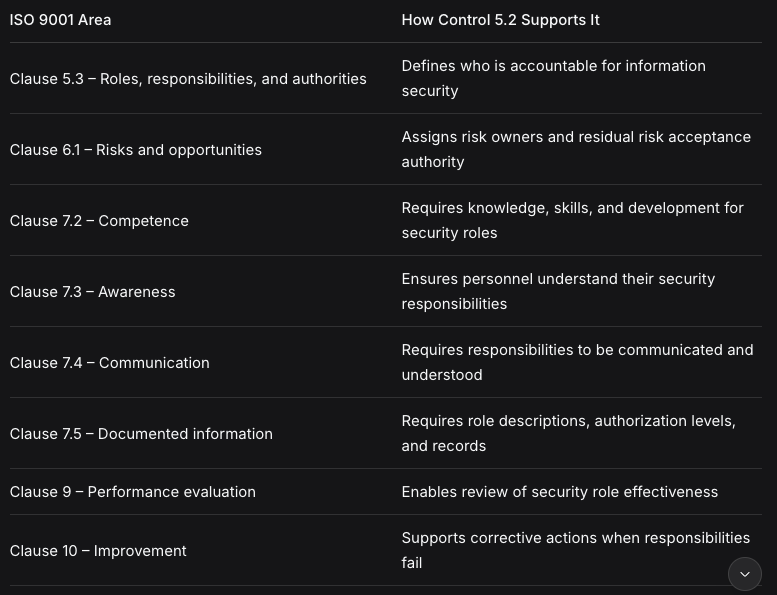
In practice, Control 5.2 helps an ISO 9001-certified organization avoid the common weakness of treating information security as “the IT department’s job.” Information security is a governance responsibility shared across the organization.
4. Practical Implementation Roadmap
Step 1: Align with the Information Security Policy
Start with Control 5.1. The top-level information security policy should state the commitment, principles, objectives, and responsibility framework. Control 5.2 then translates that policy into named roles, documented duties, and authorization levels.
Step 2: Build a Role Architecture
Define roles that fit the size, complexity, and risk profile of the organization. A typical structure may include:
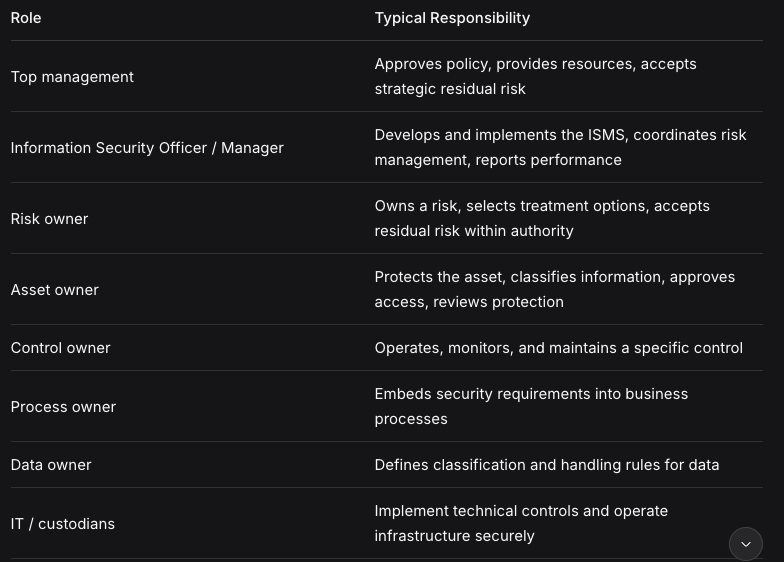
Small organizations may combine roles. Large organizations may separate them. The key is that accountability is clear.
Step 3: Use RACI to Remove Ambiguity
A RACI matrix is a highly practical tool. It identifies who is Responsible, Accountable, Consulted, and Informed for each activity.
Important: Only one person should be accountable for a given activity. Multiple people can be responsible, but accountability cannot be shared without creating gaps.
Step 4: Appoint Asset Owners and Risk Owners
A common and effective practice is to assign an owner to each asset. The asset owner is responsible for the day-to-day protection of that asset. This does not mean the asset owner performs every technical task. It means they remain accountable for ensuring protection is appropriate.
Risk owners are equally important. A risk owner must have the authority to accept residual risk. If the risk owner cannot say “yes” or “no” to a risk treatment decision, the role is only decorative.
Step 5: Define Authorization Levels
Document who can approve what. For example:
Low-risk access: line manager or asset owner;
Medium-risk access: asset owner plus information security;
High-risk access: information security officer and business owner;
Residual risk acceptance: risk owner within delegated limits;
Exceptions to policy: top management or delegated authority;
Emergency changes: predefined emergency authority with after-the-fact review.
Authorization levels should be documented, communicated, and reviewed.
Step 6: Manage Delegation Without Losing Accountability
Delegation is allowed, but accountability remains with the assigned individual. A useful rule is:
You can delegate the task, but you cannot delegate the accountability.
Managers should verify that delegated tasks are completed correctly. Evidence may include approvals, tickets, logs, review records, or meeting minutes.
Step 7: Competence, Training, and Development
People in information security roles need more than good intentions. They need knowledge and skills. Define competence requirements for each role. Examples include:
understanding ISO 27001 and ISO 9001 requirements;
risk assessment and treatment methods;
incident response procedures;
legal and contractual security requirements;
asset classification and handling;
access control principles;
business continuity and resilience.
Support continuous development through training, certifications, mentoring, conferences, internal briefings, and lessons learned from incidents.
Step 8: Communicate and Obtain Acknowledgment
Roles and responsibilities must be communicated to relevant personnel and interested parties. Personnel should acknowledge that they understand and agree to comply with applicable policies and responsibilities.
Communication methods include:
job descriptions;
role charters;
RACI matrices;
onboarding sessions;
annual security awareness training;
intranet pages;
team meetings;
performance objectives.
Step 9: Add Site-Specific and Facility-Specific Guidance
A single global role description may not be enough. Specific sites and information processing facilities may need additional responsibilities for:
physical access control;
local incident reporting;
facility monitoring;
local backup procedures;
vendor management;
emergency contacts.
Step 10: Review, Measure, and Improve
Review roles and responsibilities at planned intervals and when significant changes occur. Useful metrics include:
percentage of assets with assigned owners;
percentage of risks with assigned risk owners;
security training completion rate;
policy acknowledgment rate;
overdue risk treatment actions;
access review completion rate;
incident reporting time;
number of unresolved segregation-of-duties conflicts.
5. Common Pitfalls to Avoid
Assigning responsibility without authority. People cannot be accountable if they cannot make decisions or access resources.
Delegation without verification. Tasks may be delegated, but accountability remains.
No asset owner. Assets without owners are usually assets without protection.
Risk owners who cannot accept risk. This slows decision-making and weakens risk management.
Vague job descriptions. “Responsible for security” is not specific enough.
No authorization levels. People may approve beyond their competence or authority.
No competence requirements. A role title does not guarantee capability.
No acknowledgment. If people have not confirmed understanding, communication is incomplete.
No review after change. Reorganizations, new technology, and new regulations can make old roles obsolete.
6. Conclusion
Control 5.2 turns information security from a policy statement into an accountable operating model. For an ISO 9001-certified organization, it reinforces the same discipline that makes quality management successful: clear roles, defined authorities, competent people, documented information, communication, and continual improvement.
The most effective approach is practical, not bureaucratic. Define the roles you actually need. Assign one accountable owner per activity. Give risk owners real authority. Document authorization levels. Support competence. Require acknowledgment. Review regularly. When done well, Control 5.2 creates a structure where information security is implemented, operated, and managed reliably across the organization.